

Research backs this up. A 2025 study following bereaved adults found significantly higher rates of PTSD, depression, and anxiety nine months after loss compared to non-bereaved peers, and those symptoms didn't fade the way they did for others. Grief counseling exists because "healing" is abstract, but sleeping through the night, showing up to work, and reconnecting with people you love are not.
This article breaks down what grief counseling actually does day-to-day, not just the theory behind why it "should" help.
Key Takeaways
- Offers a judgment-free space to process loss at your own pace
- Provides coping tools like EMDR and cognitive reframing to prevent complicated grief
- Rebuilds relationships and daily routines disrupted by grief-related withdrawal
- Works best with a bereavement-trained therapist through consistent, ongoing sessions
What Is Grief Counseling?
Grief counseling is a specialized form of therapy that helps people process the emotional, cognitive, and physical impact of loss. While it's most commonly linked to the death of a loved one, it applies to a range of significant losses, including:
- Divorce or the end of a long-term relationship
- Job loss or career transitions
- The death of a pet
- A terminal diagnosis
Grief counseling isn't about "getting over" a loss or forgetting the person or thing that mattered. Instead, it supports healthy functioning and adaptation, helping someone carry their grief without it derailing their life.
Because grief affects everyone differently, this kind of support can help regardless of what caused the loss. At Meadowbrook Counseling, grief support is offered alongside trauma, anxiety, and depression treatment across office locations in Utah, Washington, Arizona, Massachusetts, Wisconsin, and Texas, both in-person and via telehealth.

Key Benefits of Grief Counseling
The benefits below focus on measurable outcomes, how someone sleeps, functions at work, and relates to others, rather than vague notions of "healing." Most people can and do grieve without professional help. But counseling becomes especially valuable when grief is complicated, prolonged, or carries a higher risk of long-term harm.
A Safe Space to Process and Understand Grief
Many people have never been taught what grief actually looks like. Counselors often introduce models like Kübler-Ross's stages (denial, anger, bargaining, depression, acceptance) to help clients feel less alarmed by their own reactions.
A caveat worth knowing: clinical reviews note these stages were originally developed for dying patients, not grieving survivors, and don't follow a strict, universal sequence. A good counselor uses them as a loose reference point, not a checklist.
What matters more is the setting itself. A confidential, judgment-free space lets clients say things they'd never say to family or coworkers, out of fear of burdening them or appearing "weak."
- Reduces the isolation of grieving in silence
- Offers validation from a trained professional, not just sympathy
- Encourages emotional expression instead of suppression, which research links to more persistent grief symptoms
- Opens the door to further support if symptoms escalate
This benefit matters most after a sudden or traumatic loss, when a client feels unsupported by friends or family, or when grief has lasted well beyond what feels like a typical adjustment period.
Practical Coping Tools That Lower the Risk of Complications
Beyond providing a space to talk, counselors teach specific techniques clients can use between sessions:
- Journaling to process thoughts that feel too big to say out loud
- Mindfulness to manage waves of overwhelming emotion as they arise
- Cognitive reframing to challenge unhelpful thought patterns tied to guilt or blame
- EMDR (Eye Movement Desensitization and Reprocessing) for grief tangled up with trauma
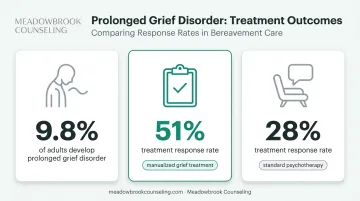
These tools matter because complicated grief isn't rare. Research estimates roughly 9.8% of adults develop prolonged grief disorder after nonviolent bereavement. Early intervention with structured techniques appears to lower this risk. One randomized trial found a manualized grief treatment produced a 51% treatment response rate, compared to 28% for standard psychotherapy.
At Meadowbrook Counseling, EMDR-certified clinicians like Rosario Toral, ACMHC, combine modalities such as CBT, ACT, and Emotionally-Focused Therapy rather than applying a single fixed protocol. The approach is client-paced: starting where someone is, not where a textbook says they should be.
These techniques prove especially valuable for high-risk grief: sudden or traumatic death, loss of a child or spouse, or a personal history of anxiety, depression, or substance use.
Restored Sense of Control, Connection, and Meaning
Loss upends routines. Grief counseling helps clients move from feeling overwhelmed by new roles and responsibilities to feeling equipped to handle them.
It also helps repair relationships strained by grief-related withdrawal. Unaddressed grief tends to drive later loneliness and depression, not the reverse, actively damaging connection over time rather than simply coexisting with it.
Counselors work on communication skills that help clients:
- Explain their needs to partners or children without shutting down
- Reconnect with friends they've been avoiding out of exhaustion
- Rebuild a sense of purpose after a major identity shift, like becoming a widow or single parent
These outcomes prove most valuable during major life transitions after loss: living alone for the first time, shifting careers, or taking on single parenting.
What Happens When Grief Is Left Unaddressed
Unprocessed grief doesn't just sit quietly. Left unaddressed, it tends to show up elsewhere:
- Prolonged grief disorder, a diagnosable condition when grief symptoms persist beyond 12 months for adults (6 months for children) and exceed cultural norms
- Higher rates of depression, PTSD, and anxiety — up to 55% of people with prolonged grief disorder also meet criteria for major depression, and 48% for PTSD
- Physical health risks, including a documented 22% higher mortality rate among widowed adults, with risk peaking in the first six months after loss
- Strained relationships, driven by withdrawal, unspoken resentment, or the sense that others "don't get it"
- Disrupted routines, making it hard to return to work, parenting, or basic daily structure
None of this means every grieving person needs therapy. It means the risks of leaving severe or prolonged grief unaddressed are well documented, not theoretical.
How to Get the Most Value from Grief Counseling
Grief counseling works best under a few specific conditions.
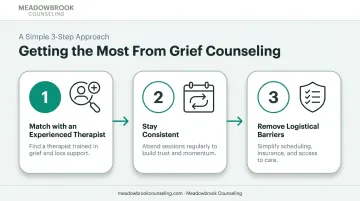
- Match with an experienced therapist. Look for someone with bereavement-specific experience, ideally with the type of loss you've faced, whether that's sudden death, loss of a child, or a terminal diagnosis in the family.
- Stay consistent. Sporadic sessions are less effective than a structured, ongoing course of care, especially during the first year after a major loss.
- Remove logistical barriers early. Insurance confusion and scheduling friction are common reasons people delay starting care.
Practices like Meadowbrook Counseling address that last point directly. They verify insurance benefits upfront and use a dedicated intake process to match clients with therapists suited to their grief and their goals. That means fewer surprises about coverage and less time spent finding the right fit on your own.
Conclusion
Grief counseling's value comes down to structure, coping tools, and connection during a time that otherwise feels disorienting. The earlier and more consistently someone engages with care, the more these benefits compound.
Reaching out for support is a practical step toward carrying loss without losing yourself in it. Meadowbrook Counseling offers grief counseling in person and via telehealth, with insurance verification handled before your first session.
Frequently Asked Questions
Why is grief counseling important?
It provides professional guidance through a process most people underestimate in length and intensity. This reduces the risk of complicated grief and the mental and physical health consequences that come with it.
What are the 3 C's of grief?
One commonly referenced version is Choose, Connect, and Communicate: choosing helpful coping strategies, connecting with supportive people, and communicating your needs. Other models exist, and a counselor can explain which framework fits your situation.
How long does grief counseling typically last?
Duration varies widely. Some people benefit from a handful of sessions, while others engage in ongoing support for a year or more, depending on the severity and type of loss.
Is grief counseling covered by insurance?
Meadowbrook Counseling accepts a wide range of insurance panels across its multi-state locations and can verify your specific coverage before your first session.
What's the difference between grief counseling and a support group?
Counseling is one-on-one with a licensed professional focused on individual processing. Support groups offer peer connection with others facing similar loss. Some people benefit from combining both.
How do I know if I need grief counseling versus managing grief on my own?
Watch for grief lasting well beyond a year, inability to function in daily life, or thoughts of self-harm. These are strong signs that professional support is worth pursuing. If you're having thoughts of self-harm, contact the 988 Suicide & Crisis Lifeline right away.