

Introduction
"How do I grieve?" It sounds like a simple question. Someone loses a parent, a marriage, a job they'd held for twenty years, and they ask it anyway, because knowing that grief exists doesn't mean anyone taught you how to move through it.
Grief is universal. The skill of processing it is not. Many people cope by staying busy, avoiding reminders, or waiting for the pain to fade on its own.
That approach often backfires. Research estimates that roughly 9.8% of bereaved adults develop prolonged grief disorder, according to a 2017 meta-analysis in the British Journal of Psychiatry. This condition causes intense symptoms that persist well past the first year and disrupt daily life.
This article breaks down what grief work means and walks through psychologist J. William Worden's Four Tasks of Mourning. It also shares coping techniques worth trying and explains when it's time to bring in professional support, including how Meadowbrook Counseling approaches grief and loss.
Key Takeaways
- Grief work means actively processing loss rather than waiting for time to heal it
- Worden's Four Tasks work as a flexible framework you can move through in any order
- Talking, movement, and creative expression all help release stuck grief
- Symptoms lasting beyond a year and blocking daily life may signal complicated grief
- Professional counseling, including EMDR, can help when self-guided efforts stall
What Is Grief Work, Exactly?
Grief work is the intentional practice of confronting a loss instead of waiting for it to fade in the background. It happens emotionally, cognitively, physically, and often spiritually.
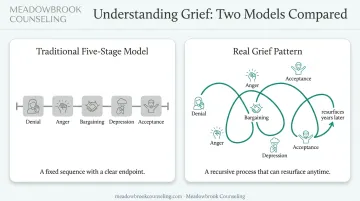
That's different from the old "five stages" idea many people grew up hearing about. Stages suggest a fixed order: denial, anger, bargaining, depression, acceptance, done. Real grief rarely cooperates with a checklist. It loops back, stalls out, and resurfaces years later at unexpected moments.
Grief, Mourning, and Bereavement Aren't the Same Thing
Mental health professionals use these three terms differently, and the distinction matters for understanding grief work:
| Term | What It Means |
|---|---|
| Grief | The internal experience — emotional, physical, and cognitive reactions to loss |
| Mourning | The outward expression of that grief, shaped by culture and personal ritual |
| Bereavement | The broader period of adjustment following a loss |
Grief work primarily targets the internal piece: the grief itself.
Leaning Into the Pain, Not Around It
The phrase "the only way out is through" captures the core philosophy of grief work: avoiding painful emotions tends to prolong them rather than reduce them.
A 2021 study followed 306 bereaved adults and found something striking. Those who showed intense, unresolved grief symptoms just five months after a loss were dramatically more likely to still meet criteria for prolonged grief disorder 18 months later. The association was strong, with an odds ratio of 13.56. Early distress isn't destiny, but it's a signal worth taking seriously.
That said, grief work isn't about nonstop confrontation. Grief researchers describe healthy coping as an oscillation, alternating between facing the loss directly and taking breaks from it to rest, laugh, or simply live.
Loss Isn't Always About Death
Grief work applies to more than death. Divorce, job loss, a serious health diagnosis, and other major transitions can trigger genuine grief. Clients coming to Meadowbrook Counseling for support with life transitions often need this same active processing, whether they're grieving:
- The end of a marriage
- A career or job loss
- A declining diagnosis, their own or a loved one's
- A move away from a faith community or identity that once defined them
Worden's Four Tasks of Mourning
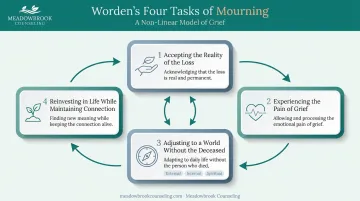
Psychologist J. William Worden reframed grief as a series of active tasks rather than passive stages you sit through. Tasks can be worked in any order, revisited repeatedly, and don't come with a deadline.
Task 1: Accepting the Reality of the Loss
Disbelief doesn't disappear overnight. It fades gradually, through repetition: talking about what happened, handling logistics like funerals or paperwork, and facing reminders again and again until the loss feels real rather than surreal.
Task 2: Experiencing the Pain of Grief
This is the task most people try to skip, and it's usually the hardest. Suppressing or fighting the pain, staying constantly distracted, and numbing with work or substances all tend to prolong suffering rather than shorten it. The emotion needs somewhere to go.
Task 3: Adjusting to a World Without the Deceased
This task unfolds across three dimensions:
- External: new responsibilities and routines the deceased once handled
- Internal: shifts in identity and self-concept ("Who am I now that I'm not a caregiver, a spouse, a parent to this child?")
- Spiritual: reworking beliefs, values, and assumptions about the world that the loss disrupted
Task 4: Reinvesting in Life While Maintaining Connection
This task centers on moving forward while keeping the connection alive. You carry your bond with the person who died into new relationships, goals, and sources of meaning, without needing to let it go.
Coping Skills and Techniques That Support Grief Work
Active grief work needs practical tools. Therapist Christina Hibbert's TEARS framework offers a simple starting point: Talking, Exercise, Artistic expression, Recording emotions, and Sobbing.
Each piece serves a purpose:
- Talking releases thoughts that otherwise loop silently in your head
- Exercise discharges the physical tension grief creates in the body
- Artistic expression gives shape to feelings that resist words
- Recording emotions creates a record you can revisit and learn from
- Sobbing is simply crying without judgment or apology
Letter-Writing and Memory Rituals
Writing a letter to the person who died, one you'll never send, can offer a strange kind of closure. Memory books, photo collections, or small annual rituals (lighting a candle on a birthday, for example) serve a similar purpose: they preserve connection instead of forcing detachment.
Journaling for Insight
Many people find that journaling helps them process what they're feeling without losing the thread of what they've learned along the way. It won't cure prolonged grief on its own. Research on expressive writing shows mixed results, but as one tool among several, journaling can offer real clarity.
Movement-Based Practices
A 2025 pilot trial testing Iyengar yoga for adults with prolonged grief found meaningful improvements in grief and depression symptoms after 10 weeks of weekly sessions. The catch: a comparison health-education group improved by a similar amount, so yoga worked best as a complement to other support, not a replacement for it.
When Grief Work Stalls: Recognizing Complicated Grief
Sometimes active grief work isn't enough on its own. Complicated grief, also called prolonged grief disorder, describes intense symptoms that persist beyond a year for adults and interfere with everyday functioning.
Warning signs worth taking seriously include:
- Struggling to accept that the loss actually occurred
- Avoiding all reminders of the person or the loss
- Feeling like part of your own identity died too
- Believing life has lost its meaning or purpose
- Experiencing numbness or a loneliness that never eases
If several of these have lingered for months and disrupted work, relationships, or daily routines, self-guided coping strategies alone may not be enough. It's a sign to connect with a grief counselor who can help you process what self-directed work couldn't reach.
How Professional Grief Counseling Can Support Your Grief Work
A grief counselor doesn't take grief away. They create a structured, safe space to do the work that avoidance has been blocking, using evidence-based approaches suited to the situation.
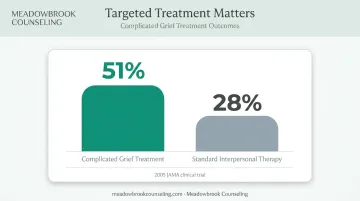
For traumatic or sudden loss, EMDR (Eye Movement Desensitization and Reprocessing) is often part of the picture. It's designed to help the brain reprocess distressing memories tied to the death so they lose some of their intrusive grip. In one randomized trial, therapy specifically designed for complicated grief produced a 51% response rate, compared to 28% for standard interpersonal therapy, according to a 2005 clinical trial published in JAMA. Targeted treatment matters.
At Meadowbrook Counseling, grief support is built around the person, not a script. That approach includes:
- EMDR-certified therapists with direct experience supporting clients through loss and major life transitions
- Offices across Utah, Washington, Arizona, Wisconsin, Massachusetts, Texas, and beyond for in-person care
- Telehealth options that make support accessible regardless of location
Our team also helps verify insurance benefits before your first session, so cost concerns don't stand between you and support. If grief has stalled and self-guided work isn't cutting it, our intake team can match you with a therapist experienced in exactly this kind of loss.
Frequently Asked Questions
What is meant by grief work?
Grief work is the active, intentional process of confronting and processing a loss, emotionally, cognitively, and physically, rather than avoiding or suppressing it. It involves tasks like accepting the loss, feeling the pain, and adjusting to life afterward.
What are coping skills for grief?
Effective coping tools include talking about the loss, physical exercise, creative or artistic expression, journaling, and allowing yourself to cry. Letter-writing and memory rituals can also help maintain connection while processing pain.
What are the three C's of grief?
Grief researcher Kenneth Doka's Choose, Communicate, and Compromise framework helps people navigate holidays and anniversaries after a loss. It means deciding which traditions to keep, sharing that choice with others, and finding middle ground when needs differ.
How long does grief work typically take?
There's no fixed timeline. Healing depends on the relationship, the circumstances of the loss, and individual coping style. Support, whether from loved ones or a therapist, tends to speed adjustment rather than shorten grief itself.
Can grief work be done without a therapist?
Many people process grief successfully using self-guided coping techniques like talking, journaling, and physical activity. Professional support becomes important when symptoms are prolonged, intense, or interfere with daily functioning.