Introduction
Love is supposed to feel safe. Yet for many people, even the healthiest relationships come with a steady hum of worry: Does my partner still want to be here? Was that text short because they're mad at me?
This pattern is called relationship anxiety, and it's more common than most couples admit.
Left unchecked, it shows up as constant reassurance-seeking, replaying conversations for hidden meaning, or bracing for abandonment that never comes. Over time, that pattern chips away at connection and peace of mind, even when your partner hasn't done anything wrong.
This guide breaks down the signs of relationship anxiety, what actually causes it, and practical ways to manage it. We'll also cover when it's time to bring in a therapist rather than white-knuckle it alone.
Key Takeaways
- Relationship anxiety is common and doesn't mean your relationship is failing.
- Warning signs include reassurance-seeking, overanalyzing texts, jealousy, and physical stress symptoms.
- Attachment style, past betrayals, and low self-esteem fuel anxiety more than your partner's actions.
- Mindfulness, honest communication, and boundaries can break the anxious-thought cycle.
- Therapy, individual or couples-based, helps when anxiety disrupts daily life.
What Is Relationship Anxiety and What Are the Signs?
Relationship anxiety is persistent worry, doubt, or fear about a romantic partnership, regardless of how stable it actually is. It's not a formal clinical diagnosis. Researchers describe it more as a pattern of hyperactivation, meaning your nervous system treats a partner's neutral behavior like a threat to be watched and managed.
This is different from Relationship OCD, where worries become intrusive, repetitive, and nearly impossible to control through logic alone. If your doubts feel obsessive rather than situational, that distinction matters for treatment.
Is It Normal to Feel Anxious in a New Relationship?
Yes, mostly. Trust hasn't been built yet, so some uncertainty is expected. Psychologists distinguish this from persistent attachment anxiety, which is a more chronic pattern of abandonment worry rather than doubt tied to an unclear relationship stage.
What matters more is whether that nervousness fades as trust builds, or lingers long after your partner has proven reliable.
Common Signs of Relationship Anxiety
Watch for these patterns:
- Constant need for reassurance ("Do you still love me?" asked repeatedly)
- Overanalyzing texts, tone, or delayed replies
- Fear of abandonment, even without evidence
- Jealousy or insecurity that feels disproportionate to the situation
- Difficulty trusting, even when your partner is consistent
- Self-silencing or avoiding conflict to prevent rejection
- Emotional reactions that feel bigger than the trigger
Anxiety also shows up physically. Racing heart, an upset stomach, muscle tension, or fatigue during relational stress are common. This isn't just "being dramatic." A 2013 review of 124 dating couples found that attachment-anxious men showed greater cortisol reactivity while anticipating conflict, along with slower recovery afterward. Your body reacts to relationship stress the same way it reacts to other threats.
What Causes Relationship Anxiety?
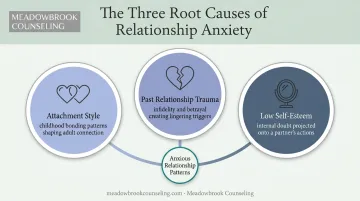
Relationship anxiety rarely originates with your current partner. It usually traces back further, shaped by three underlying factors:
Attachment style. How you bonded with caregivers as a child shapes how you connect as an adult. Anxious attachment produces clinginess and hypervigilance about a partner's feelings, while avoidant attachment creates discomfort with closeness. Neither pattern is fixed—both can shift through later relationships.
Past relationship trauma. Infidelity, sudden breakups, or being misled leave lingering triggers, even with a trustworthy current partner. One 2019 study found 45.2% of unmarried adults who experienced partner infidelity reported symptoms suggesting probable infidelity-related PTSD. That kind of history doesn't just disappear when you meet someone new.
Low self-esteem and general anxiety. If you already doubt your own worth, it's easy to project that doubt onto your partner's actions. A slightly distracted response can suddenly feel like proof you're not enough, even when nothing has changed.
How to Deal With Relationship Anxiety: Practical Ways to Cope
Managing relationship anxiety takes a two-part approach: working on your internal experience and communicating with your partner.
How to Talk About Relationship Anxiety With Your Partner
Choose a calm moment, not the middle of a conflict. Use "I" statements:
- "I've noticed I get anxious when texts go unanswered for a while."
- "I sometimes spiral into worst-case scenarios, and it's not about anything you've done."
- "I feel more secure when we check in, even with a quick text."
Framing this as your internal experience, rather than an accusation, invites support instead of defensiveness. Your partner can't fix a feeling they don't know exists.
How to Help an Anxious Partner
If you're on the receiving end, consistent, judgment-free reassurance helps, but it's not the whole answer. Encourage your partner to build their own coping tools alongside your support.
Here's why that balance matters: researchers studying partner accommodation (changing routines or repeatedly reassuring a partner to reduce their distress) found that frequent accommodation can strengthen the link between anxiety and conflict rather than resolve it. Reassurance offers short-term relief, but it can reinforce the anxiety cycle over time.
Self-Directed Coping Strategies
Try these approaches:
- Practice mindfulness. Notice anxious thoughts without immediately acting on them. Even five minutes of focused breathing can interrupt a spiral.
- Challenge catastrophic thinking. When your brain jumps to "they're going to leave me," ask what evidence actually supports that versus what you're assuming.
- Protect your identity outside the relationship. Hobbies and friendships reduce over-dependence on one person for your sense of self-worth.
- Set healthy boundaries. Boundaries build mutual trust and reduce the urge to monitor your partner's every move.
A 2022 diary study of 110 couples found that attachment anxiety predicted higher rates of daily excessive reassurance-seeking, particularly among men. Recognizing that pattern in yourself is the first step toward interrupting it.
When Relationship Anxiety Needs Professional Support
Self-help strategies go a long way, but some signs call for more structured support:
- Anxiety disrupts sleep, work, or daily functioning
- Physical symptoms (racing heart, stomach issues, tension) persist regularly
- Anxious patterns have caused repeated relationship sabotage
The National Institute of Mental Health recommends seeking professional help when distressing symptoms last two weeks or more and start affecting sleep, concentration, or daily tasks.
Individual therapy helps you work through attachment patterns and self-esteem at the root. Couples therapy addresses the dynamic between you and your partner directly. Both can be valuable, and sometimes both at once.
Meadowbrook Counseling matches clients with therapists trained in evidence-based approaches like CBT and EMDR, which are widely used for anxiety and attachment-related concerns.
The practice verifies insurance benefits before your first session, so you know your coverage upfront. Locations span Utah, Washington, Arizona, Wisconsin, Massachusetts, and Texas, with telehealth available in select states.

Frequently Asked Questions
Is it normal to feel anxious in a new relationship?
Yes. Trust and attachment take time to build, so some early doubt is normal. It becomes worth addressing if the anxiety persists well after your partner has shown consistent reliability.
How to talk about relationship anxiety with your partner?
Use "I" statements during a calm moment, not mid-argument. Frame it as your own internal experience rather than something your partner is doing wrong.
How to help an anxious partner?
Offer steady, judgment-free reassurance while gently encouraging them to build independent coping skills. If the pattern doesn't ease, professional support can help both of you.
What causes relationship anxiety?
Attachment style, past relationship trauma like infidelity, and low self-esteem are the most common contributing factors. It's rarely about your current partner's actual behavior.
Does relationship anxiety go away?
It can improve with self-awareness, open communication, and sometimes therapy. It doesn't usually disappear overnight, but the intensity and frequency typically decrease.
Is relationship anxiety a sign something is wrong with my relationship?
Usually not. It often stems from internal patterns rather than real relationship problems. That said, genuine red flags should still be evaluated on their own, separate from anxiety.