
Introduction
She got the promotion. She has the marriage friends envy and the résumé that turns heads.
Yet she still rehearses apologies for taking up space in a meeting, brushes off compliments before they land, and quietly assumes every mistake proves what she's always suspected: she's not enough.
This pattern is far more common than most people realize, and it rarely announces itself. Low self-esteem tends to work in the background, shaping careers, relationships, and mental health without ever getting named directly.
Research shows the stakes are real: low self-esteem predicts later depression more strongly than depression predicts low self-esteem, according to Sowislo and Orth's landmark meta-analysis.
Cognitive behavior therapy (CBT) is one of the most studied treatments for this problem. Below, we'll cover what low self-esteem actually looks like, why the CBT model explains it so well, and which techniques help people rebuild a healthier sense of self-worth.
Key Takeaways
- Low self-esteem is a learned thinking pattern, not a fixed trait, so it can be unlearned
- CBT addresses core beliefs, rigid "rules for living," and self-critical thought-and-avoidance cycles
- Cognitive restructuring, behavioral experiments, and self-compassion practice have the strongest research support
- A licensed therapist, like those at Meadowbrook Counseling, can speed progress with personalized care
Understanding Low Self-Esteem: Signs, Causes, and Impact
Self-esteem is the ongoing opinion a person holds about their own worth. Someone with healthy self-esteem can acknowledge flaws without spiraling. Someone with low self-esteem treats every flaw as proof of a deeper inadequacy.
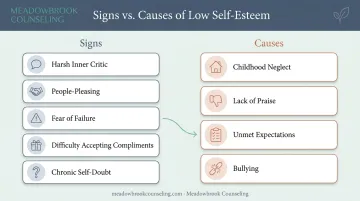
Common Signs to Watch For
- Harsh, critical inner dialogue that wouldn't be tolerated toward a friend
- People-pleasing, even at personal cost
- Fear of failure or criticism that leads to avoidance
- Difficulty accepting compliments or praise at face value
- Chronic self-doubt that shows up regardless of actual achievement
Where It Typically Comes From
Low self-esteem typically develops gradually, shaped by several overlapping experiences rather than one single event. Common contributors include:
- Childhood punishment, neglect, or inconsistent affection
- Insufficient praise, warmth, or encouragement growing up
- Repeatedly failing to meet parental or peer expectations
- Bullying, exclusion, or feeling like an outsider
The Impact on Daily Life
Low self-esteem rarely stays contained to private thoughts. It shapes how people set boundaries, pursue opportunities, and interpret feedback at work and in relationships. Left unaddressed, it often compounds into chronic anxiety, depression, or avoidance patterns that quietly limit personal growth.
Self-esteem sits on a spectrum. Some people struggle only in specific arenas, such as work performance or dating, while others feel it color nearly every interaction. Neither version is "less real" than the other, and both respond to the same underlying treatment approach.
The CBT Model for Low Self-Esteem: Why It Persists
Psychologist Dr. Melanie Fennell developed the cognitive-behavioral model that most modern CBT for self-esteem is built on. Her framework explains something more useful than causes: what keeps low self-esteem locked in place long after the original experiences have passed.
Core Beliefs: Your "Bottom Line"
Early experiences, like harsh criticism or chronic neglect, plant a deep belief such as "I'm not good enough" or "I'm unlovable." This belief doesn't feel like an opinion. It feels like a fact, because it's been reinforced for years.
Rules for Living
To avoid confronting that painful bottom line, people build rigid rules: "I must never fail," "I must please everyone," "I must always be in control." These rules offer temporary protection, but their rigidity makes them fragile the moment life doesn't cooperate.
The Vicious Cycle That Keeps It Going
When a rule gets threatened, a predictable sequence kicks in:
- An anxious prediction fires ("They'll think I'm incompetent")
- Avoidance or safety behavior follows (staying quiet, over-preparing, people-pleasing)
- The outcome, even if neutral, gets filtered through the original belief
- The bottom line feels confirmed all over again
This is exactly why willpower and positive thinking alone rarely fix low self-esteem. The cycle doesn't respond to pep talks. It responds to direct evidence against the belief itself.
A 2018 systematic review of Fennell-model interventions found strong posttreatment effect sizes for structured weekly CBT programs. The authors noted, though, that more research is needed to isolate which specific components drive the change.
Proven CBT Techniques to Build Healthier Self-Esteem
CBT provides specific, actionable tools that dismantle low self-esteem. At Meadowbrook Counseling, therapists guide clients through techniques that target each stage of Fennell's cycle.
Cognitive Restructuring
This starts with catching automatic negative thoughts as they happen and giving the inner critic a name. From there, clients deliberately build a second, more realistic "healthy voice" that responds with balanced evidence instead of judgment.
Identifying Cognitive Distortions
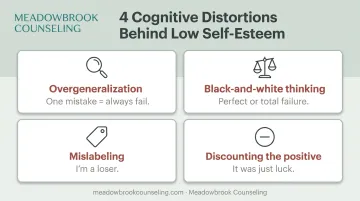
Low self-esteem thrives on distorted thinking patterns:
- Overgeneralization – one mistake means you always fail
- Black-and-white thinking – you're either perfect or a total failure
- Mislabeling – a single setback becomes a permanent identity ("I'm a loser")
- Discounting the positive – achievements get dismissed as luck, timing, or other people's help
Socratic questioning, where a therapist gently asks "What's the evidence for that?" or "Would you judge a friend this harshly?", helps loosen these patterns without confrontation.
Behavioral Experiments
Instead of just thinking differently, clients test their fears directly: saying no to a request, voicing an unpopular opinion, or skipping a safety behavior. The actual outcome, compared against the feared outcome, becomes hard evidence against the core belief. For example, a client who fears rejection might ask a colleague for help and observe that nothing catastrophic happens.
Developing Flexible New Rules
Working with a therapist, clients trade rigid demands ("I must never disappoint anyone") for realistic standards ("I can disappoint people occasionally and still be worthy"). Clients test these new rules in real situations, not just agree to them on paper.
Practicing Self-Compassion
Self-compassion means responding to your own struggles the way you'd respond to a friend's, with kindness instead of criticism. A 2022 meta-analysis of self-compassion interventions found a meaningful reduction in self-criticism across nearly 1,350 participants.
Progress here isn't instant. Consistent practice, not a single breakthrough session, is what gradually rewires beliefs that took years to form.
What to Expect From CBT for Low Self-Esteem
A first session usually looks less like a diagnosis and more like detective work. Therapist and client map out three things together:
- Specific situations that trigger distress
- Thoughts that show up in those moments
- Patterns that follow from those thoughts
From there, CBT tends to be structured and goal-oriented:
- Sessions build on each other rather than covering random topics
- Homework between sessions, like thought records or planned behavioral experiments, is standard
- Progress gets tracked, not just discussed
This same structure holds whether CBT happens one-on-one or in a group setting, depending on what's available and what fits the person's comfort level.
When low self-esteem is tangled up with past trauma, some therapists also draw on EMDR (Eye Movement Desensitization and Reprocessing) alongside CBT tools. Trauma-rooted beliefs sometimes need memory-focused work in addition to thought-based work.
Finding Professional CBT Support for Low Self-Esteem
Self-help strategies such as journaling, thought records, and self-compassion exercises genuinely help. But a licensed therapist can spot blind spots that are nearly impossible to see on your own, and personalize the pace and approach to your specific history.
Meadowbrook Counseling offers CBT among its evidence-based therapy options, matched to each client through a dedicated intake process rather than a one-size-fits-all program. Several therapists on staff bring direct relevance to self-esteem work:
- Dr. Kristine Andersen (PsyD) lists self-esteem concerns as a primary specialization, alongside CBT, DBT, and trauma-informed care
- Amber Rangel (LCSW) specifically addresses "poor self-image" using CBT, DBT, and ACT
- Jonathan Nash (CMHC) and Jonathan Malley (LMFT) combine CBT with EMDR for clients whose self-esteem struggles are tied to trauma

Meadowbrook also supports insurance verification before your first appointment. With locations across Massachusetts, Utah, Idaho, Texas, Florida, Colorado, and Wisconsin, starting therapy doesn't require added logistical stress on top of everything else.
Frequently Asked Questions
How can I overcome low self-esteem?
Start by identifying the specific negative beliefs driving your self-doubt, then challenge them with real evidence and practice self-compassion consistently. Therapy, especially CBT, can speed up this process considerably.
Can cognitive therapy (CBT) help with low self-esteem?
Yes. CBT is one of the most well-researched treatments for low self-esteem because it directly targets core beliefs and the self-critical patterns that keep them alive.
What is the 5-minute rule in CBT?
It's a behavioral technique where you commit to just five minutes on a task you've been avoiding. Once you start, momentum often makes it easier to continue past the five-minute mark.
How long does CBT for low self-esteem usually take?
It varies by individual, but many structured programs run several weeks to a few months of regular sessions. Your specific timeline depends on how long-standing the patterns are.
Can I improve low self-esteem without therapy?
Self-help tools like journaling and self-compassion exercises can genuinely help. However, professional support is recommended when patterns feel deeply rooted or resistant to change on your own.
What's the difference between low self-esteem and low self-confidence?
Self-esteem is a broad, global sense of your overall worth as a person. Self-confidence is usually tied to specific skills or situations, like public speaking or a particular job task.