
Many people experience anxiety and depression as one tangled knot, not two separate problems. That's part of the confusion. Nearly half of people with major depression also meet criteria for an anxiety disorder at some point in their lives, according to research published in the American Journal of Psychiatry. Yet the two conditions are clinically distinct, which means treating them as one blurry problem can leave people stuck.
This article breaks down why anxiety and depression overlap so often, how to tell their symptoms apart, and what evidence-based treatment looks like when both show up at once.
Key Takeaways
- Depression and anxiety are separate diagnoses, but 46% of people with depression also have anxiety
- Either condition can trigger the other, creating a cycle of worry, self-criticism, and low mood
- Shared symptoms like fatigue and poor sleep make self-diagnosis unreliable
- CBT, medication, and lifestyle changes work best when both conditions are treated together
- A therapist trained in multiple modalities can identify your best treatment path
Understanding the Anxiety-Depression Connection
Anxiety and depression aren't the same disorder wearing two different masks. Clinically, they're defined by different core features.
Major depressive disorder (MDD) requires at least five of nine symptoms lasting most of the day, nearly every day, for a minimum two-week period, per the DSM-5-TR. At least one symptom must be depressed mood or a loss of interest in things you used to enjoy.
Generalized anxiety disorder (GAD), by contrast, involves excessive worry that's hard to control, occurring more days than not for at least six months, alongside at least three physical or cognitive symptoms like restlessness or muscle tension.
Anxiety tends to run hot: racing thoughts, a body braced for danger, energy with nowhere to go. Depression runs cold: flat mood, low energy, a sense that nothing matters. But here's where it gets messy — one condition can quietly feed the other.
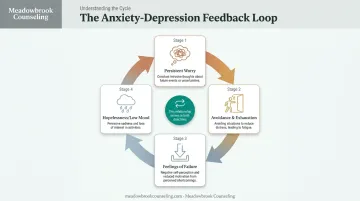
Think of it as a cycle:
- Persistent worry leads to avoidance or exhaustion
- Avoidance and exhaustion create feelings of failure
- Feelings of failure spiral into hopelessness, a hallmark of depression
Research backs this up. A meta-analysis of 66 longitudinal studies and more than 88,000 participants found the relationship runs both directions: anxiety symptoms predicted later depressive symptoms, and depressive symptoms predicted later anxiety, with comparably strong effects each way. Neither condition simply causes the other in a straight line. They reinforce each other.
Part of this overlap traces back to biology. Both conditions involve overlapping brain circuits tied to emotion regulation, particularly the amygdala and prefrontal cortex, along with shared neurotransmitter systems including serotonin and norepinephrine.
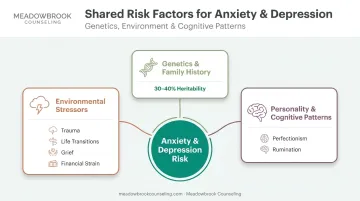
Genetics matter too: twin studies estimate anxiety and depression are each roughly 30% to 40% heritable, and a family history of either condition raises your risk for both.
Can You Have Both Anxiety and Depression at the Same Time?
Yes. This is a recognized comorbid presentation, not a rare exception. A major depressive episode can trigger anxiety symptoms severe enough to meet criteria for a separate anxiety disorder.
The reverse happens too: someone with generalized anxiety disorder or panic disorder can develop depression after months of unrelenting worry wears them down. Clinicians see this combination often enough that most treatment guidelines address it directly rather than treating it as unusual.
Overlapping Symptoms and Warning Signs
Anxiety and depression share enough symptoms that people often can't tell which one they're dealing with, or whether it's both.
Symptoms common to both conditions include:
- Fatigue and low energy
- Sleep disturbances (too little or too much)
- Appetite or weight changes
- Difficulty concentrating or making decisions
- Irritability
- Reduced ability to function at work, school, or home
Despite the overlap, each condition has distinguishing features:
| Anxiety | Depression |
|---|---|
| Racing thoughts, excessive worry | Persistent sadness or emptiness |
| Restlessness, feeling "on edge" | Loss of interest in activities once enjoyed |
| Muscle tension, physical arousal | Hopelessness, worthlessness, or guilt |
| Difficulty controlling worry | Psychomotor slowing or heavy fatigue |
This overlap can mask what's really going on. Someone with underlying depression might notice only the fatigue and assume they're anxious about falling behind. Someone with primary anxiety might interpret their exhaustion as depression setting in, when the root cause is chronic worry draining their reserves.
That's exactly why self-diagnosis is risky. A licensed therapist, like those at Meadowbrook Counseling, can use structured screening tools and clinical interviews to sort out which symptoms belong to which condition, and whether both are present. Guessing based on internet checklists tends to delay the right treatment.
Shared Causes and Risk Factors
Anxiety and depression don't appear at random. Several risk factors raise the odds of developing either condition, or both at once.
Genetics and family history
If a parent or sibling has struggled with anxiety or depression, your own risk increases for both conditions, not just the one they experienced. Twin studies suggest meaningful shared genetic liability between the two disorders.
Environmental stressors
- Childhood trauma or abuse
- Major life transitions, like divorce or job loss
- Chronic financial or relationship strain
- Grief and bereavement
- Serious illness or injury
Personality and cognitive patterns
If you're prone to perfectionism, rumination, or persistent negative thinking, you face higher risk for both conditions. Researchers call these patterns "transdiagnostic," meaning they don't just predict one disorder; they fuel vulnerability across several.
None of these factors guarantee you'll develop anxiety or depression. They shift the odds, which is why two people facing similar stressors can end up with very different outcomes.
Treatment Options That Address Both Conditions
Effective treatment rarely isolates anxiety from depression. Most evidence-based approaches address both at once, since they share overlapping mechanisms.
Cognitive Behavioral Therapy (CBT)
CBT is a first-line treatment for both conditions. It targets the distorted thinking patterns, like catastrophizing or all-or-nothing thinking, that drive both excessive worry and hopelessness. Sessions typically run weekly for 12 to 15 weeks, though this varies with symptom severity.
Medication
Providers commonly prescribe SSRIs and SNRIs for both anxiety and depression because they act on shared neurotransmitter systems. A 2025 Cochrane review found antidepressants produced a 41% higher probability of treatment response than placebo in short-term GAD trials. Medication decisions should always involve a prescribing provider who can weigh your specific history.
Trauma-Focused Approaches
When past trauma fuels both anxiety and depression, trauma-focused therapies like EMDR (Eye Movement Desensitization and Reprocessing) can process what talk therapy alone sometimes can't reach. At Meadowbrook Counseling, clinicians such as Rosario Toral, a Clinical Mental Health Counselor and certified EMDR practitioner, work specifically with clients whose anxiety, depression, and trauma symptoms are intertwined.
Lifestyle Interventions
Lifestyle changes won't replace therapy or medication, but they meaningfully support recovery:
- Exercise — large-scale reviews link regular movement to consistent symptom reductions for both depression and anxiety
- Sleep hygiene — improving sleep quality is tied to measurable drops in both conditions
- Reduced alcohol use — alcohol may ease anxiety briefly, but heavy or repeated drinking tends to worsen both conditions over time
Building a Personalized Plan
Treating anxiety and depression as separate, unrelated problems rarely works, since the two conditions interact. A personalized plan considers which symptoms are most severe, what's driving them, and which modality fits your history.
Before your first session at Meadowbrook Counseling, the team helps verify your insurance benefits and connects you with a therapist whose specialization matches your presentation, whether that's CBT, EMDR, or another evidence-based approach. Self-pay rates run $180 to $200 for an intake session and $135 to $160 for follow-up sessions, depending on the clinician's license type.
How to Support a Loved One With Anxiety and Depression
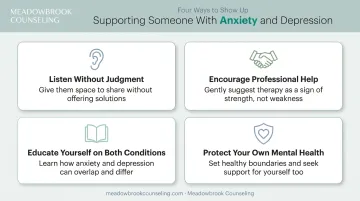
Watching someone you care about struggle with anxiety and depression can leave you feeling helpless. A few practical approaches make a real difference:
- Listen without judgment. Resist the urge to minimize their feelings—phrases like "just relax" shut people down rather than help.
- Gently encourage professional help. Offer to research therapists or verify insurance together. Meadowbrook Counseling's intake team confirms benefits before your loved one's first appointment, removing a common booking barrier.
- Educate yourself on both conditions. Fatigue, irritability, and withdrawal are often symptoms, not character flaws; understanding this builds patience over frustration.
- Protect your own mental health too. Caregiving is draining, so set boundaries, lean on your support system, and consider therapy yourself if it becomes too much.
Frequently Asked Questions
How do I help a person with depression and anxiety?
Listen without judgment, avoid minimizing their experience, and gently encourage professional treatment. Offer practical help, like researching therapists or checking insurance, rather than unsolicited advice.
What are the 3 C's of depression?
The 3 C's are a CBT technique: Catch it (notice the negative thought), Check it (examine whether it's accurate), and Change it (replace it with a more balanced thought).
What is the difference between anxiety and depression?
Anxiety tends to involve high-energy worry, racing thoughts, and physical tension. Depression involves low-energy sadness, hopelessness, and a loss of interest in activities you once enjoyed.
Can anxiety cause depression, or does depression cause anxiety?
Either can trigger the other. Research shows the relationship runs in both directions, with anxiety predicting later depression and depression predicting later anxiety at similar rates.
How do doctors diagnose someone with both anxiety and depression?
Clinicians use DSM-5 criteria, a detailed symptom history, and screening tools like the PHQ-9 and GAD-7, followed by a full clinical interview to confirm findings.
When should I seek professional help for anxiety and depression?
Seek help if symptoms last more than two weeks or interfere with daily functioning. If you're having thoughts of self-harm, call or text 988 immediately for crisis support. Otherwise, NIMH recommends connecting with a licensed therapist, like the providers at Meadowbrook Counseling, sooner rather than later.