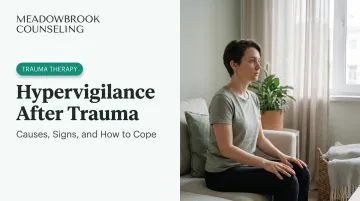
If this sounds familiar, you're not "too sensitive" or overreacting. You're likely experiencing hypervigilance, one of the most common yet misunderstood effects of trauma. It gets mislabeled as anxiety, a personality quirk, or a control issue, when it's actually your nervous system doing exactly what it learned to do to keep you safe.
This guide breaks down what causes hypervigilance, how to recognize it in yourself or someone you love, and evidence-based ways to cope, including when trauma therapy like EMDR can help you finally feel safe again.
Key Takeaways
- Hypervigilance is a nervous system response, not a personality flaw or overreaction
- Common causes include combat exposure, abuse, domestic violence, medical trauma, and chronic instability
- Symptoms show up emotionally, physically, and behaviorally, often disguised as perfectionism
- Self-help tools ease symptoms; EMDR-based trauma therapy addresses the root cause
What Is Hypervigilance After Trauma?
Hypervigilance is a persistent state of alertness in which your nervous system gets stuck in fight-or-flight mode. You scan for danger even when you're objectively safe: at home, at work, in bed at 2 a.m.
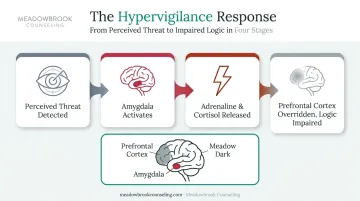
Here's what's happening biologically. Your amygdala, the brain's threat detector, overreacts to perceived danger. It floods your body with adrenaline and cortisol, priming you to fight, flee, or freeze.
This response overrides your prefrontal cortex, the part of your brain responsible for logical decision-making. That's why hypervigilant moments can feel impossible to reason your way out of, no matter how hard you try.
Understanding this brain response also clarifies where hypervigilance fits diagnostically. Hypervigilance is a symptom, not a standalone diagnosis. It's officially recognized within the DSM-5's PTSD criteria for arousal and reactivity. At least two of six specific symptoms, including hypervigilance and an exaggerated startle response, must begin or worsen after a traumatic event.
You'll typically see it alongside:
- Post-Traumatic Stress Disorder (PTSD)
- Complex PTSD (C-PTSD)
- Generalized anxiety disorder
- Other trauma-related conditions
It rarely shows up alone. Recognizing that overlap can help you and your therapist target treatment more precisely.
What Causes Hypervigilance After Trauma?
Hypervigilance develops as a learned survival adaptation. Your brain got good at detecting subtle warning signs, because at some point, those signs predicted real danger. This isn't a malfunction. It's your nervous system doing its job a little too well, long after the threat has passed.
Types of Trauma Commonly Linked to Hypervigilance
Certain experiences are especially likely to wire the brain for constant threat detection:
- Single-incident trauma: Combat exposure, physical or sexual assault, and violent crime victimization
- Developmental trauma: Childhood abuse, neglect, or growing up in an unpredictable or volatile household
- Domestic violence: Intimate partner abuse, where danger could erupt at any moment
- Medical trauma: Serious illness, invasive procedures, or extended hospitalization
You don't need one dramatic incident, either. Chronic, lower-grade stress, such as prolonged caregiving, ongoing workplace instability, or repeated discrimination, can accumulate into full hypervigilance over time, even without a single identifiable "major" trauma.
The numbers back up how common this is. In a clinical sample of 171 trauma-exposed patients using the International Trauma Questionnaire, being "on guard" was endorsed by 88.9% of those with probable PTSD and 97.8% of those with probable C-PTSD. Among the same groups, jumpiness or an exaggerated startle response was endorsed by 72.2% and 92.1%, respectively.
That's not a rare side effect. For people already struggling with trauma symptoms, hypervigilance is closer to the norm than the exception.
Recognizing the Signs and Symptoms of Hypervigilance
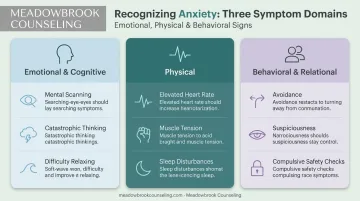
Hypervigilance symptoms typically cluster across three interconnected domains. They rarely show up in isolation from other trauma responses, which is part of why they're so exhausting to live with.
Emotional & Cognitive Signs
- Constant mental scanning for danger, even in low-risk settings
- Catastrophic thinking ("something bad is about to happen")
- Difficulty relaxing mentally or "switching off"
- Reading too much into neutral comments, tones, or facial expressions
Physical Signs
- Elevated heart rate and blood pressure
- Chronic muscle tension, especially in the jaw, shoulders, and neck
- An exaggerated startle response to sudden noises or movement
- Sleep disturbances that lead to ongoing exhaustion
Behavioral & Relational Signs
- Avoiding crowds, unfamiliar places, or certain routes
- Suspiciousness of others' motives, even loved ones
- Difficulty trusting close relationships
- Compulsive safety behaviors, such as checking locks repeatedly or always sitting facing the exit
Here's something that often gets missed: hypervigilance can masquerade as productivity or perfectionism. Many high-functioning trauma survivors channel that constant alertness into overachievement, staying ahead at work and anticipating everyone's needs while privately running on fumes.
From the outside, it looks like drive. From the inside, it's exhaustion dressed up as diligence.
Hypervigilance vs. OCD, Anxiety & Paranoia
Hypervigilance, OCD, and generalized anxiety share real overlap. All three involve intrusive worry, fight-or-flight activation, and a hard time tolerating uncertainty. That overlap is exactly why so many people get misdiagnosed or self-diagnose incorrectly.
Here's how they actually differ:
| Condition | What drives it | Focus |
|---|---|---|
| Hypervigilance | Trauma-linked threat response | Scanning for relational or physical danger in the moment |
| OCD | Obsessions paired with compulsions | Repetitive rituals aimed at neutralizing a specific feared outcome |
| Generalized anxiety | Broad, hard-to-control worry | Future outcomes or performance, not moment-to-moment danger |
| Paranoia | Fixed, delusional beliefs | Conviction that others intend harm, held despite contrary evidence |
The clearest distinction involves self-awareness: hypervigilant individuals usually know their fear response is disproportionate, even if they can't turn it off. Paranoia, by contrast, involves a fixed belief that doesn't budge when presented with contrary evidence.
If your symptoms overlap several of these categories or feel confusing to untangle on your own, working with a licensed therapist, like those at Meadowbrook Counseling, can clarify what's actually happening and help determine which treatment path fits best.
Understanding High-Functioning C-PTSD and Hypervigilance
Complex PTSD (C-PTSD) develops from prolonged, repeated trauma: long-term childhood abuse, ongoing domestic violence, or years spent in an unsafe environment. Alongside hypervigilance, it typically includes emotional dysregulation and a persistently negative sense of self.
"High-functioning" C-PTSD isn't a formal clinical term. It describes someone who meets every work deadline, shows up for family, and maintains friendships—all while privately carrying hypervigilance, perfectionism, and emotional numbing.
This combination hides well, which is exactly the problem:
- Colleagues see competence, not struggle
- Family sees reliability, not exhaustion
- The person themselves often minimizes what they're carrying because "everything looks fine"
Because these symptoms hide behind achievement, high-functioning C-PTSD often goes unrecognized for years. Early self-awareness, paired with professional support, matters more here than almost any other trauma presentation, precisely because nothing on the outside is signaling that something's wrong.
How to Cope With and Treat Hypervigilance After Trauma
Your nervous system needs to relearn what safety actually feels like. That process takes practice and, often, professional support.
Practical Self-Help Strategies
Start with tools that regulate your nervous system in the moment:
- Ground yourself with your senses. Try the 5-4-3-2-1 exercise: name 5 things you see, 4 you can touch, 3 you hear, 2 you smell, and 1 you taste.
- Slow your breathing. Extend your exhale longer than your inhale to signal safety to your body.
- Challenge catastrophic thoughts. Pause and ask, "What else might be true right now?" before reacting to a perceived threat.
- Adjust daily habits. Cut back on caffeine and alcohol, protect consistent sleep, and limit exposure to triggering content.
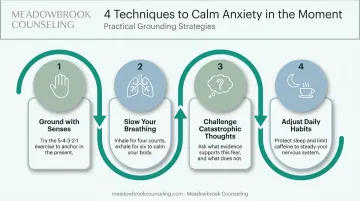
These strategies offer real, immediate relief. But they manage symptoms; they don't address why your nervous system got wired this way in the first place.
Professional & Evidence-Based Treatment
Trauma-focused therapy targets the root cause. Both the WHO and VA/DoD identify EMDR and trauma-focused CBT among the recommended psychotherapies for PTSD, meaning these are established, first-line treatments for PTSD.
EMDR (Eye Movement Desensitization and Reprocessing) works by helping your brain reprocess traumatic memories that are still fueling your threat response, so your nervous system stops treating old danger as current danger.
At Meadowbrook Counseling, trauma care includes EMDR-certified clinicians like Rosario Toral, ACMHC, who brings both clinical training and a lived-experience perspective to trauma treatment. Meadowbrook also offers:
- Personalized therapist matching based on your specific needs and history
- Insurance benefits verification before your first session, so cost concerns don't delay care
- Access across multiple states, with both in-person and telehealth options at select locations
If hypervigilance is disrupting your sleep, your work, or your relationships, that's a sign worth taking seriously. With consistent, trauma-informed treatment, these symptoms can improve. You can verify your insurance benefits before booking, which removes one more barrier to getting started.
Frequently Asked Questions
What kind of trauma causes hypervigilance?
Combat exposure, physical or sexual assault, domestic violence, medical trauma, and chronic childhood instability are all common triggers. Prolonged lower-grade stress, like ongoing caregiving or workplace instability, can also build into hypervigilance over time.
Is hypervigilance a symptom of OCD?
Not typically. Hypervigilance is more closely tied to PTSD and trauma responses, though it can overlap with OCD's anxiety and uncertainty-related features. OCD is specifically defined by compulsions aimed at neutralizing obsessive fears.
What is high-functioning C-PTSD?
It describes someone with C-PTSD who maintains outward functioning (work, relationships, responsibilities) while privately experiencing hypervigilance, emotional numbing, and related symptoms. It's an informal term, not an official diagnostic category.
Can hypervigilance go away without treatment?
Symptoms may ease somewhat with reduced life stress, but they often persist or worsen if the underlying trauma isn't addressed. Professional treatment tends to speed up and deepen recovery.
How is hypervigilance treated in therapy?
EMDR, trauma-focused CBT, and nervous system regulation techniques are the most common evidence-based approaches. A therapist can help determine which fits your specific history and symptoms best.
Is hypervigilance the same as paranoia?
No. Hypervigilance involves a self-aware fear response to perceived threat, while paranoia involves fixed, delusional beliefs that persist despite contrary evidence. They're often confused but are clinically distinct experiences.