If that sounds familiar, you've probably wondered whether marriage counseling actually works, or if it's just an expensive way to confirm what you already suspect. That question comes loaded with hope, fear, and a healthy dose of skepticism.
This article looks at what the research actually shows: real success-rate data, how counseling works mechanically, when it tends to help most, and how to tell if it's the right move for your relationship right now.
Key Takeaways
- Marriage counseling has a research-backed track record, but success depends on both partners fully engaging.
- Counseling works by giving couples tools and structure, not by fixing one "broken" partner.
- It isn't a cure-all: active abuse, untreated addiction, or one-sided disengagement can limit its effectiveness.
- Starting early, before resentment calcifies, consistently produces better results.
What Percentage of Marriages Are Saved by Counseling?
There's no single, tidy percentage that answers "will counseling save my marriage." Anyone promising you an exact number is oversimplifying a messy, human process. But the data does paint a picture.
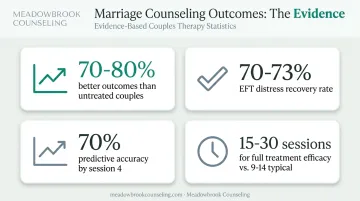
A comprehensive 2022 review of couple therapy outcomes found that the average person who received treatment ended up better off than 70% to 80% of people who received no treatment at all, according to research reviewed by Lebow and colleagues. That's a meaningful comparative benefit, though it measures relative improvement, not a guarantee of staying married.
Method-specific numbers add more texture. Reviews of Emotionally Focused Couple Therapy (EFT) trials found that roughly 70% to 73% of couples recovered from significant relationship distress by the end of treatment. A large meta-analysis of 58 studies covering over 2,000 couples found relationship satisfaction improved substantially in treated couples, compared to almost no change in couples left on a waitlist.
Why Session Count and Timing Matter
Outcome isn't just about showing up once or twice. In one study tracking 136 couples, therapists could predict whether a couple would ultimately succeed or struggle with 70% accuracy by the fourth session. That's not proof that four sessions fix anything. It's a signal that early momentum (or the lack of it) tends to hold true.
Research-based treatment models often run 15 to 30 sessions for full efficacy, while typical outpatient practice sees more like 9 to 14. Fewer sessions can still help, but the depth of change is usually smaller.
Redefining What "Success" Means
Here's something a lot of couples don't expect going in: many therapists don't define success as "staying together at all costs." Some couples leave therapy with clearer communication and a stronger marriage. Others leave with clarity that separating is healthier for both people, minus the years of unresolved conflict.
Both outcomes count as success in a clinical sense. The goal is clarity and reduced harm, not a forced reunion.
Satisfaction with the experience of therapy tends to be high, even when the relationship outcome is mixed. Couples often report feeling heard and understood by their therapist, regardless of whether they ultimately stay together.
How Marriage Counseling Helps Save a Marriage
Counseling gives couples structure, tools, and perspective that are almost impossible to build on their own, mid-argument, at 11 p.m., after a long day.
Improves Communication in a Neutral Space
Most couples don't have a communication disorder. They have communication habits that stopped working years ago. A therapist slows conversations down enough to interrupt the reflexive back-and-forth.
- Teaches active listening instead of rehearsed rebuttals
- Breaks the cycle of interrupting or "winning" the argument
- Replaces vague complaints ("you never help") with specific, actionable requests
That same neutral setting changes the dynamic at home, where disagreements escalate fast because there's no referee and no rules. Both partners get equal airtime, and nobody gets to dominate the narrative. Because the therapist has no stake in "winning," couples often say things in session they'd never say at the kitchen table.
Identifies and Breaks Damaging Patterns
The fight about dishes is rarely about dishes. Surface arguments over money, chores, or parenting often mask older wounds: feeling unappreciated, feeling controlled, or carrying resentment from years back. Trained therapists are skilled at spotting these patterns and gently redirecting the conversation toward what's actually driving the conflict.
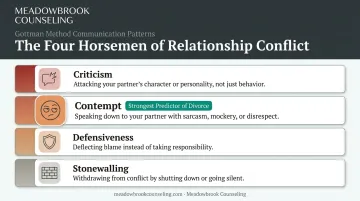
These underlying wounds often show up as recognizable, damaging patterns. Psychologist John Gottman spent decades studying couples and identified four communication patterns that reliably predict divorce, known as the Four Horsemen: criticism, contempt, defensiveness, and stonewalling. Of the four, contempt is considered the single strongest predictor of divorce, according to the Gottman Institute.
Counseling helps couples:
- Recognize these patterns in real time, often for the first time
- Interrupt the pattern before it escalates
- Replace it with a healthier response, such as expressing a need instead of leveling an attack
Several therapists at Meadowbrook Counseling, including those trained in the Gottman Method and Emotionally Focused Therapy, build sessions directly around identifying these patterns and coaching couples toward healthier alternatives.
When Marriage Counseling Works Best — and When It Might Not
Counseling isn't magic; it works better under certain conditions and struggles under others. Knowing which category your relationship falls into can save you time, money, and heartache.
When Counseling Tends to Succeed
Therapy tends to work best when:
- Both partners are genuinely open to change, not just attending to appease the other
- Issues are addressed early, before resentment has years to build
- There's still honesty and vulnerability possible in sessions, even if it's uncomfortable
- Both people show basic respect for each other's wellbeing, even mid-conflict
A five-year follow-up study of 134 chronically distressed couples found that higher commitment levels before treatment predicted better outcomes over time. Even shaky commitment, it turns out, matters more than people expect.
When Counseling May Not Be Enough
Therapy has real limits too, and it tends to struggle when:
- One partner is completely unwilling to participate or has already emotionally checked out
- There's ongoing abuse or coercive control, where safety must come first, not reconciliation
- Active, untreated addiction is driving the conflict (specialized treatment is often needed alongside or before couples work)
- Betrayal has occurred repeatedly without any real attempt to address it
Even when none of these red flags apply, timing your expectations matters. A quick caution: expecting instant results after one or two sessions is a setup for disappointment, since real change usually unfolds over months, not days.
Signs Your Marriage Could Benefit From Counseling
You don't need to be on the brink of divorce to benefit from counseling. In fact, waiting until things are dire often makes the work harder. Common signs it might be time include:
- Frequent arguments that never get resolved, just paused
- Communication that's broken down into silence or sniping
- Feeling more like roommates or co-parents than partners
- Trust issues, whether from infidelity or smaller betrayals that piled up
- Major life transitions (job loss, a new baby, financial strain) creating ongoing tension
One study of nearly 100 couples entering therapy found that stressors outside the relationship and communication problems were the two most common presenting issues. Each accounted for roughly a quarter of all concerns raised in the study.
These signs show up at every stage of marriage, not just the early years. Long-term couples navigating empty-nest transitions or retirement face their own version of the same disconnect. Reframing these signs as early warning lights, rather than proof of failure, tends to produce better outcomes than waiting it out.
Taking the Next Step: Finding the Right Support
Reaching out for counseling is a sign that you still care enough to fight for the relationship instead of letting it drift.
The method matters less than most people assume. Fit with your therapist matters just as much, if not more, since comfort and trust drive real engagement in sessions. A couple that feels judged or misunderstood by their therapist won't do the deeper work, no matter how evidence-based the technique is.
At Meadowbrook Counseling, couples can work with therapists trained in:
- Gottman Method
- Emotionally Focused Therapy
- EMDR, when trauma is affecting the relationship
Locations across Utah, Massachusetts, Idaho, Washington, Arizona, Wisconsin, and Texas offer these sessions in-person or via telehealth. The team also verifies your insurance benefits before your first appointment, so you know what to expect financially.

If you're on the fence, that hesitation is normal. Most people are.
Frequently Asked Questions
What percent of marriages are saved by counseling?
There's no single universal figure, but research shows treated couples fare better than 70-80% of untreated couples, and EFT-specific studies report 70-73% distress recovery. Outcomes vary based on early intervention and both partners' engagement.
Do marriage counselors try to keep couples together?
No. Therapists remain neutral, focusing on helping couples build communication tools and gain clarity, whether that means reconnecting or separating with less conflict and more mutual understanding.
How long does marriage counseling take to work?
Timelines vary, but early progress often becomes noticeable by the fourth session. Full treatment courses commonly run three to twelve months, depending on the couple's goals and the severity of the issues.
Can marriage counseling work if only one partner is willing to go?
Individual therapy can still create positive ripple effects on the relationship. However, deeper, lasting relationship change typically requires both partners eventually participating in some form of joint work.
Is it normal to feel worse before feeling better in couples therapy?
Yes. Surfacing buried resentments or old wounds can feel uncomfortable at first. This discomfort is often part of the process, not a sign that therapy is failing.
When is it too late for marriage counseling?
It's rarely "too late" unless one partner has fully disengaged or safety concerns like abuse are present. Earlier is better, but many couples see meaningful progress even after years of difficulty.