If this sounds familiar, you're not overreacting. You're experiencing health anxiety (sometimes diagnosed as illness anxiety disorder), a cycle where normal body sensations get misread as danger signals. It feels relentless, but it isn't unbreakable.
Mindfulness offers a research-backed way to interrupt that spiral before it takes over your day. Below, we'll explain why it works specifically for health anxiety, then walk through six exercises you can start using right now.
Key Takeaways
- Health anxiety cycles through body-focus, misinterpretation, and rumination — mindfulness disrupts it early
- Grounding, breathing, and body scans calm physical symptoms without feeding symptom-checking habits
- Daily practice on calm days matters more than reacting only during flare-ups
- Mindfulness pairs best with professional therapy for anxiety that's persistent or severe
Understanding the Health Anxiety Cycle (And Why Mindfulness Helps)
Health anxiety rarely looks like one big panic moment. It usually shows up as smaller, repeated behaviors:
- Checking your pulse, skin, or a lump multiple times a day
- Booking doctor visits for sensations that resolve on their own
- Falling into hours-long research spirals after noticing a symptom
- Asking friends, family, or partners for reassurance that you're okay
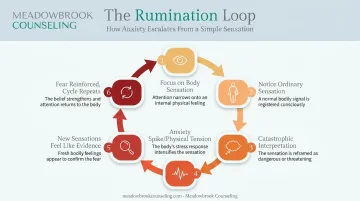
The Rumination Loop
Here's how it typically unfolds:
- You focus attention on a body part or sensation
- You notice something ordinary, like a muscle twitch or mild fatigue
- Your brain interprets it catastrophically ("this could be serious")
- Anxiety spikes, raising heart rate and muscle tension
- Those new physical sensations feel like more "evidence"
- The fear gets reinforced, and the cycle repeats
Checking behaviors and reassurance-seeking might feel like they help, but they usually keep the belief alive by preventing you from ever disproving the fear, according to a 2024 review published in Current Psychiatry Reports.
Where Mindfulness Fits In
Mindfulness doesn't argue with the catastrophic thought. It changes your relationship to it. Instead of fusing with "something is wrong," you learn to notice the thought as a mental event, not a medical fact. This is called cognitive defusion.
There's real clinical evidence behind this approach. A randomized trial of 74 adults diagnosed with hypochondriasis found that eight weeks of mindfulness-based cognitive therapy (MBCT), added to usual care, produced meaningfully lower health anxiety scores than usual care alone.
The effect size was moderate right after treatment and grew stronger at the one-year mark, according to a 2012 study in the Journal of Consulting and Clinical Psychology. Half the MBCT group no longer met criteria for hypochondriasis after treatment, compared to about a fifth of the comparison group.
There's also a physical component. Slow, intentional breathing can help increase vagally mediated heart rate variability, a marker of your body shifting toward a calmer, parasympathetic state rather than staying stuck in fight-or-flight arousal.
6 Mindfulness Exercises to Calm Health Anxiety
These exercises work best as a regular habit, not just a rescue tool for panic moments. Try a few and notice which ones actually settle your body instead of feeding your worry.
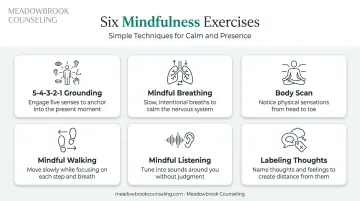
The 5-4-3-2-1 Grounding Technique
This exercise pulls your attention outward, away from internal body-scanning.
- 5 things you see: colors, shapes, objects in the room
- 4 things you touch: texture of your clothing, a chair, the floor
- 3 things you hear: traffic, a fan, your own breathing
- 2 things you smell: coffee, soap, fresh air
- 1 thing you taste: gum, water, the inside of your mouth
By the time you finish, your nervous system has something concrete to focus on besides the sensation that worried you.
Mindful Breathing
Inhale slowly through your nose for about four counts, then exhale even more slowly through your mouth for six to eight counts. The extended exhale is what signals your body to relax.
Do this for two to three minutes. It won't cure a racing heart instantly, but it directly counters the shallow, rapid breathing that often mimics (and worsens) the physical symptoms people mistake for illness.
Body Scan Without Symptom-Checking
A body scan and anxious self-monitoring can look similar from the outside, but they're not the same thing.
- Anxious checking asks: "Is this dangerous? What does this mean?"
- Mindful scanning asks nothing. It simply notices: "There's tension here. There's warmth there."
Move attention slowly from your feet to your head, describing sensations neutrally (tight, warm, tingling) without labeling them as symptoms of anything. If a scary thought pops up, acknowledge it and return to the scan.
Mindful Walking
Walk slower than you normally would. Notice your foot lifting, moving, and landing. Notice the temperature of the air or the sound of your footsteps.
This exercise grounds you physically while keeping you active, which is useful when sitting still feels like it gives worry too much room to grow.
Mindful Listening or Music
Pick a song or ambient sound and actively listen, rather than letting it play in the background. Notice the layers: an instrument, a rhythm, a pitch change.
When your mind drifts back to symptom-worry, gently redirect it to the sound. This trains the same attention-shifting muscle used in grounding.
Labeling Thoughts (Cognitive Defusion in Practice)
When a worrying thought appears, silently name it: "There's the thought that something is wrong." Or simply: "Worrying."
This small shift creates distance between you and the thought. You stop treating it as fact and start treating it as one mental event passing through, which is the core skill behind cognitive defusion.
Building a Sustainable Mindfulness Habit
Consistency matters more than duration. Start with 5-10 minutes daily, ideally at the same time each day, and build from there.
A few practical ways to make it stick:
- Pair it with an existing habit — practice while your coffee brews or right after brushing your teeth
- Set a phone reminder for the same time each day rather than relying on willpower
- Use a mindfulness app with guided sessions if silence feels harder to sit with
- Practice on calm days, not just anxious ones. This is when the skill actually gets built
Beyond these daily strategies, it helps to know how much practice actual research used. Clinical research on MBCT programs for health anxiety involved far more practice than most people expect: eight weekly two-hour sessions plus roughly an hour of home practice most days. That's not a requirement for everyone, but it shows the skill takes real repetition to develop fully. Don't expect five minutes once a week to undo years of body-focused worry.
Mindfulness Mistakes That Can Backfire on Health Anxiety
Mindfulness can accidentally reinforce health anxiety when it's practiced the wrong way, so watch for these three traps.
Turning body scans into symptom hunts means scanning your body for proof that something's wrong, which is checking behavior wearing a mindfulness costume rather than neutral observation.
Expecting instant relief ignores that one session won't erase months of anxious body-focus. Clinical trials showing real benefit ran for eight weeks or longer, so give the practice time before deciding it doesn't work.
Trying to force thoughts away by suppression often makes an anxious thought louder later. The skill is observing the thought without judgment and letting it pass, the same way you'd notice a cloud drifting through the sky, rather than eliminating it.
When Mindfulness Isn't Enough: Getting Professional Support
Mindfulness is a genuinely useful self-help tool, but it has limits. For health anxiety that's persistent, severe, or interfering with daily life, research supports pairing it with structured therapy such as cognitive behavioral therapy (CBT) or MBCT delivered by a trained clinician.
This is where Meadowbrook Counseling can help. The practice offers personalized, evidence-based therapy, including:
- CBT, ACT, and EMDR delivered by licensed clinicians
- Offices across Utah, Washington, Arizona, Wisconsin, Massachusetts, Texas, Idaho, Florida, and Colorado
- In-person and telehealth appointments, depending on your location and therapist
Before your first session, Meadowbrook's billing team verifies your specific insurance plan and therapist combination, so you know what's covered upfront. For clients without in-network coverage, self-pay rates typically range from $135 to $200 per session depending on the therapist's credentials and session type.
If health anxiety has been running your days, reaching out for a consultation is a reasonable next step. A therapist can help you build a coping plan that combines mindfulness with clinical tools designed for your specific pattern of worry.
Frequently Asked Questions
How do you fight health anxiety?
Combine mindfulness practices with cognitive reframing of catastrophic thoughts, and limit reassurance-seeking behaviors like repeated searching or checking. Professional therapy, such as CBT, adds structured support for persistent cases.
How to stop physical anxiety symptoms?
Slow diaphragmatic breathing, grounding techniques like 5-4-3-2-1, and progressive muscle relaxation can calm your nervous system quickly. These work by directly countering the physical arousal that drives anxious sensations.
What is the 3-3-3 rule in mindfulness?
It's a fast grounding technique: name three things you see, three things you hear, and move three parts of your body. It aims to interrupt anxious spirals in the moment.
How long does it take for mindfulness to reduce anxiety?
Some relief can happen within minutes through slower breathing and reduced physical tension. Lasting changes in how you respond to anxiety typically take several weeks of consistent practice to build.
Can mindfulness replace therapy for health anxiety?
Mindfulness is a valuable complement, but it's not a replacement for professional treatment when health anxiety is moderate to severe. Structured therapy from providers like Meadowbrook Counseling addresses the underlying patterns that mindfulness alone may not fully resolve.