

Heartbreak isn't just an emotional metaphor. Researchers have found that romantic rejection and physical pain activate overlapping regions in the brain. This doesn't mean the pain is imaginary. It means your brain is treating loss the way it treats injury.
The good news: you don't have to white-knuckle your way through it. This article breaks down why heartbreak hurts so much, how therapy helps you move through it, which approaches actually work, and when it's time to reach out for support.
Key Takeaways
- Heartbreak causes real physical and emotional stress, not only sadness
- Healing moves through recognizable stages, but rarely in a straight line
- Therapy offers structured tools that speed healing, beyond simple venting
- CBT, EMDR, and attachment-based therapy each address different heartbreak needs
- Professional support matters most when heartbreak starts disrupting daily life
What Is Therapy for Heartbreak?
Heartbreak therapy is a form of talk therapy focused on helping people process the grief, identity disruption, and emotional pain that follow a breakup, divorce, or lost relationship.
This approach applies across a range of situations, including:
- The breakup happening last week or eight months ago
- You initiating the split or being on the receiving end
- Guilt, relief, anger, or grief surfacing regardless of who ended things
Therapy focuses on rebuilding emotional stability, understanding what happened, and reconnecting with the sense of self a breakup often shakes loose. The goal isn't erasing your feelings for an ex or hitting an arbitrary deadline to "get over it."
The Emotional Stages of Heartbreak
Many therapists use a stages-based framework, adapted loosely from grief models, to help you normalize what you're feeling as you move through heartbreak. This model was originally developed to describe terminally ill patients, not breakups specifically—so think of it as a mirror reflecting common emotional territory, not a fixed map with guaranteed exits.
Five stages commonly show up as you move through heartbreak recovery:
- Denial or shock - Numbness, disbelief, or a sense that this can't really be happening
- Anger - Frustration directed at the ex-partner, yourself, or the situation itself
- Bargaining or rumination - Replaying the relationship, wondering "what if," or imagining reconciliation
- Depression or sadness - A heavier, more settled grief as the loss becomes real
- Acceptance and growth - Finding stability and starting to reinvest in your own life
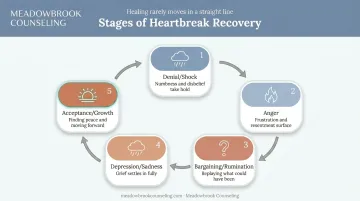
Here's the catch: these stages rarely move in order. You may cycle back through anger or rumination well after you thought you'd reached acceptance. That's not a setback; that's how grief actually works.
Key Ways Therapy Helps You Heal From Heartbreak
The benefits below reflect real, observable shifts in how people think, feel, and behave after a breakup once they start working with a therapist.
A Safe, Non-Judgmental Space to Process Pain
Friends and family love you, but they get tired of hearing about your ex. Eventually, even well-meaning people start hinting that it's time to "just get over it."
Therapy doesn't work that way. It's a space where you can repeat the same story five different ways until it finally makes sense to you.
That matters more than it might seem. Suppressing painful emotions is linked to prolonged rumination, and rumination itself has been shown to predict greater emotional distress after a breakup. One study of 560 young adults found rumination was directly tied to emotional distress and indirectly worsened it through avoidant coping patterns.
This kind of processing supports:
- Better emotional regulation
- Reduced feelings of isolation
- Faster movement through the grief cycle
This matters most immediately after a breakup, or when your usual support system feels tapped out.
Breaking Unhealthy Patterns and Building Self-Awareness
Sometimes a breakup points to a deeper pattern, not just one relationship. Therapists trained in attachment-based or psychodynamic work help you trace anxious or avoidant relationship habits back to earlier experiences, sometimes as far back as childhood.
This isn't navel-gazing. A study following 196 emerging adults found that attachment anxiety and avoidance both predicted "self-punishing" coping after a breakup, which in turn predicted higher depression and anxiety months later. Left unaddressed, these patterns tend to repeat.
Understanding your own attachment tendencies supports:
- Identity rebuilding after a breakup
- Healthier relationship choices going forward
- Stronger, more grounded self-worth
You'll notice the biggest shift if you have a history of painful breakups or a pattern of struggling to set boundaries.
Practical Coping Tools for Emotional Regulation
Heartbreak reaches beyond your thoughts, disrupting your sleep, focus, appetite, and anxiety levels. Therapy equips you with concrete tools, such as cognitive reframing, grounding exercises, and mindfulness practices, to manage both the mental and physical symptoms.
These techniques work because they interrupt intrusive thought loops before they spiral. Instead of lying awake at 2 a.m. replaying a conversation, you have an actual practice to redirect that energy.
The payoff includes:
- More consistent sleep
- Sharper focus at work or school
- Lower day-to-day anxiety
These tools prove especially valuable when symptoms start bleeding into daily functioning, not just during emotional moments.
What Happens When Heartbreak Is Left Untreated
Not everyone needs therapy after every breakup. But when heartbreak goes unprocessed for too long, certain patterns tend to show up:
- Prolonged rumination and a sense of being emotionally stuck in the past
- Recurrent unhealthy relationship patterns, including rebound cycles that repeat old dynamics
- Worsening anxiety, depression, or social withdrawal that spreads beyond the relationship itself
- Diminished self-worth that quietly follows you into future relationships
- Reliance on avoidance or substance use as a way to numb the discomfort instead of moving through it
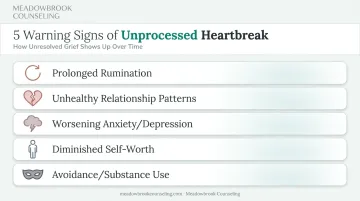
None of this means something is wrong with you. It means unprocessed pain doesn't just disappear; it resurfaces in other areas of life, often when you least expect it.
Finding the Right Therapy Approach for Your Healing Journey
Different therapy modalities address different layers of heartbreak. The right approach depends on what's actually driving the pain, whether that's distorted thinking, unresolved trauma, or attachment wounds resurfacing.
Cognitive Behavioral Therapy (CBT)
CBT helps identify and challenge distorted thoughts that heartbreak tends to produce, like "I'll always be alone" or "I'll never trust anyone again." By naming and questioning these thoughts, clients often see real reductions in depression and anxiety symptoms over time.
EMDR (Eye Movement Desensitization and Reprocessing)
Some breakups don't just hurt. They resurface older wounds, especially when a relationship echoes past rejection, abandonment, or trauma. EMDR helps process those deeper layers rather than just the surface-level sadness.
At Meadowbrook Counseling, clinicians including EMDR-trained therapist Rosario Toral use this evidence-based modality alongside CBT and solutions-focused approaches to help clients work through breakup-related distress and build lasting resilience.
Attachment-Based and Mindfulness-Based Therapy
Attachment-based therapy explores the early relationship patterns that shape how you connect (or disconnect) as an adult. Mindfulness-based approaches, meanwhile, reduce rumination and build present-moment acceptance instead of getting stuck relitigating the past.
Because everyone's breakup story is different, Meadowbrook Counseling matches clients with therapists whose training fits their specific situation. That might mean CBT, EMDR, attachment work, or a blend of approaches.
Moving Forward
Heartbreak is painful, but it isn't permanent. Therapy gives you structure, tools, and support to move through the stages of healing instead of getting stuck in one of them.
Healing isn't linear. You'll have good weeks and bad weeks, sometimes good hours and bad hours. That's normal. What speeds things along is having support in your corner rather than white-knuckling it alone.
If you're considering reaching out, Meadowbrook Counseling offers insurance verification support and a therapist network across states including Utah, Washington, Arizona, Wisconsin, Massachusetts, and Texas. This makes it easier to find the right fit and start sessions with less financial guesswork.
Frequently Asked Questions
Is there therapy for heartbreak?
Yes. Licensed therapists specialize in breakup and heartbreak recovery using evidence-based approaches like CBT, EMDR, and attachment-based therapy. You don't need a diagnosis to start, just a desire to process what you're feeling.
How do I heal my heart after a breakup?
Healing usually combines self-compassion, leaning on your support system, and professional guidance when needed. There's no single fix, but consistency across all three tends to speed things along.
What are the 5 stages of heartbreak?
The commonly referenced stages are denial, anger, bargaining, depression, and acceptance. Most people don't move through them in order, and revisiting earlier stages is completely normal.
How long does it take to heal from heartbreak?
There's no fixed timeline. Recovery depends on relationship length, attachment style, and the support available to you, with some people stabilizing in months and others needing longer.
What type of therapy is best for a breakup?
It depends on what's driving your distress. CBT works well for distorted thinking, EMDR helps with deeper trauma or triggered old wounds, and attachment-based therapy targets recurring relationship patterns.
When should I consider seeking therapy after a breakup?
Consider reaching out if sadness persists without easing, daily functioning suffers, or you notice yourself leaning on unhealthy coping mechanisms like avoidance or substance use to get through the day.