

But for some, grief doesn't follow that gentler path. Instead, the way a loved one died keeps replaying in the mind, triggering panic, nightmares, or a constant sense of danger that has nothing to do with sadness alone.
This is where grief and Post-Traumatic Stress Disorder (PTSD) can intersect. Grief is a natural, expected response to loss. PTSD is a distinct, diagnosable condition that can develop when a death was sudden, violent, or witnessed firsthand.
This article breaks down how grief and PTSD differ, what warning signs matter most, and which evidence-based treatments (including options available at Meadowbrook Counseling) actually help survivors heal.
Key Takeaways
- Grief and PTSD overlap, but PTSD adds specific symptoms like flashbacks, hypervigilance, and avoidance
- Sudden, violent, or witnessed deaths raise the risk of PTSD in survivors
- Recovery from grief doesn't follow a fixed "5 stages" timeline—the process is non-linear
- CBT and EMDR both have strong research support for treating grief-related trauma
Understanding the Link Between PTSD and Grief
The American Psychological Association defines grief as the anguish that follows significant loss, often marked by yearning, confusion, dwelling on the past, and worry about the future.
PTSD is different. Per the DSM-5 and Mayo Clinic, it's a condition triggered by directly experiencing, witnessing, or learning about a traumatic event involving death, serious injury, or violence.
When someone learns about the death of a close family member or friend, it must have been violent or accidental for the loss to qualify under PTSD's diagnostic criteria.
So, can losing a loved one actually cause PTSD? Yes. This is especially true when the death was:
- Sudden and unexpected
- Violent or accidental
- Witnessed directly by the survivor
The Research Behind Traumatic Grief
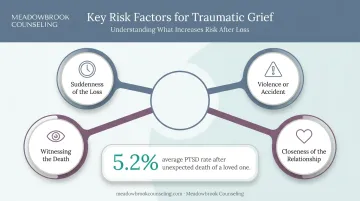
A large-scale analysis of World Mental Health Surveys, spanning 19 countries and over 78,000 respondents, found that among people whose most significant trauma was the unexpected death of a loved one, PTSD developed in an average of 5.2% of cases across countries, according to Atwoli and colleagues' cross-national analysis.
That same research found risk climbs further after the death of a spouse or child, or when the survivor believed the death could have been prevented.
This heightened risk has a clinical name. Clinicians use the term traumatic bereavement (sometimes called traumatic grief) to describe this combined trauma-and-loss response. It's not a separate diagnosis in the DSM-5, but it's a widely used clinical description for grief that has crossed into trauma territory.
Several factors raise the risk of traumatic grief developing:
- Suddenness of the death, with no time to prepare
- Violence or accident involved in how the person died
- Witnessing the death firsthand
- Closeness of the relationship to the deceased
Unlike standard grief, which tends to ease naturally over weeks to months, traumatic grief usually needs professional support to resolve.
Recognizing Symptoms: Is It Grief or PTSD?
Normal grief brings sadness, yearning, and disrupted routines. These feelings come in waves. They soften over time, and they rarely block every area of a person's life.
PTSD looks different. It goes beyond mourning into a set of trauma responses that can take over daily functioning.
Hallmark PTSD Symptoms
- Intrusive flashbacks or nightmares replaying the death
- Hypervigilance, or feeling constantly on edge or scanning for danger
- Emotional numbness that blocks connection to others
- Persistent avoidance of people, places, or conversations tied to the loss
Physical symptoms often ride alongside these mental ones. Heart palpitations, sweating, shaking, and panic-like reactions can show up when something reminds the person of the death.
These somatic responses can persist long-term. A study of parents and siblings bereaved by a mass violence event found complaints like palpitations and fatigue lingering alongside PTSD symptoms even eight years later.
The Timeline That Matters
Clinicians look at duration and severity. If intense symptoms last beyond one month and interfere with daily life, that's a signal PTSD may be present rather than typical grief.
Guilt is another distinguishing marker. Many people with grief-related PTSD develop distorted beliefs, like feeling personally responsible for not preventing the death, even when nothing could have changed the outcome. Research on bereaved spouses found early self-blame linked to more severe, longer-lasting grief, while general regret didn't carry the same weight.
The Stages of Grief vs. PTSD: What's the Real Difference?
The "five stages of grief," denial, anger, bargaining, depression, and acceptance, come from Elisabeth Kübler-Ross's 1969 work with terminally ill patients facing their own deaths. It was never designed to map how survivors process someone else's death, let alone diagnose PTSD.
A 2021 systematic review found no evidence supporting the five stages as a universal, linear sequence. People skip stages, revisit them, or experience several at once. Modern grief researchers now describe the process as far messier than the popular model suggests.
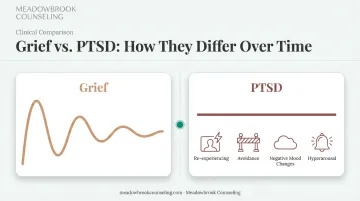
PTSD is a separate clinical diagnosis, not a stage of grief. It has its own criteria:
- Re-experiencing the trauma (flashbacks, nightmares)
- Avoidance of reminders
- Negative changes in mood or thinking
- Heightened arousal and reactivity
Here's the practical distinction: grief tends to arrive in waves that gradually soften. Untreated PTSD symptoms, on the other hand, often stay constant or even worsen without intervention. That difference alone is often what tells clinicians which condition they're dealing with. A licensed therapist trained in trauma-focused care, such as EMDR, can help clarify which one you're experiencing and guide the right treatment.
Complicated Grief and Traumatic Bereavement: When Mourning Becomes More
Most grief eases with time and support. But for some, it doesn't. Prolonged grief disorder (also called complicated grief or persistent complex bereavement disorder) is the clinical term for mourning that stays severe and impairing well past what's expected.
A meta-analysis by Lundorff and colleagues estimated that roughly 9.8% of bereaved adults develop prolonged grief disorder following predominantly nonviolent deaths. That rate climbs considerably higher after unnatural or violent losses.
Where Complicated Grief and PTSD Overlap
The two conditions frequently occur together. One clinical review found that 48% of a treatment-seeking sample with complicated grief also met full criteria for PTSD. That's a striking overlap, though it reflects a specific treatment-seeking group rather than the general population.
Warning signs that grief may be evolving into something more serious include:
- Preoccupation with the death that crowds out daily thoughts
- A sense that life feels unbearable or meaningless
- Avoidance so severe it disrupts relationships, work, or routines
- Persistent identity disruption or disbelief about the loss
If these patterns last beyond a year for adults (or six months for children), it's worth a professional evaluation. Meadowbrook Counseling's therapists provide grief-focused, trauma-informed care, including EMDR, to help determine whether complicated grief or PTSD is at play and guide you toward healing.
Treatment That Works: Healing from Grief-Related PTSD
Here's the reassuring part: grief-related PTSD responds well to treatment. Healing doesn't mean forgetting the person you lost. It means being able to remember them without your nervous system reacting as if the trauma is happening right now.
Cognitive Behavioral Therapy (CBT)
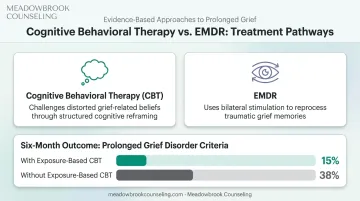
CBT helps survivors identify and challenge the distorted beliefs that often accompany traumatic loss, like guilt, self-blame, or the conviction that they should have somehow prevented the death.
According to Bryant and colleagues' research published in JAMA Psychiatry, a randomized clinical trial tested grief-focused CBT with exposure techniques. At six-month follow-up, just 15% of participants still met criteria for prolonged grief disorder, compared to 38% in a comparison group without the exposure component. That's a meaningful difference for a condition that can otherwise feel permanent.
EMDR (Eye Movement Desensitization and Reprocessing)
EMDR uses bilateral stimulation, typically guided eye movements, to help the brain reprocess traumatic memories of a loved one's death. Over time, this reduces the intensity of flashbacks and nightmares tied to the loss.
At Meadowbrook Counseling, EMDR is delivered by certified clinicians such as Rosario Toral, ACMHC, who works with clients processing traumatic loss in a compassionate, structured setting. Rosario also brings experience as a certified Peer Recovery Specialist, blending clinical training with a grounded understanding of what recovery actually requires.
Getting Personalized Support
If symptoms have lasted beyond a month and are disrupting your daily life, it's worth talking to a licensed therapist for a full evaluation.
Meadowbrook Counseling offers:
- Personalized therapist matching based on your specific concerns
- Insurance verification support before your first session
- Multiple U.S. locations across Utah, Washington, Arizona, Wisconsin, Massachusetts, and Texas
- In-person and telehealth scheduling options
Starting treatment shouldn't feel like another obstacle on top of your grief. Meadowbrook Counseling's intake team handles the logistics, so you can focus on healing.
Frequently Asked Questions
Does losing a loved one cause PTSD?
Yes, sudden, violent, or witnessed deaths can trigger PTSD in survivors, though not everyone who grieves develops it. Traumatic circumstances of death, such as accidents or witnessing the event, sharply raise that risk.
What are the 5 stages of grief PTSD?
There's no such diagnosis. The "5 stages of grief" is a grief model, not a PTSD criterion, and modern research shows grief doesn't follow a fixed, linear sequence at all.
How long does PTSD from grief typically last?
Without treatment, symptoms can persist for months or years. With therapies like CBT or EMDR, many people see real improvement within weeks to months.
Is complicated grief the same as PTSD?
No, they're distinct diagnoses that share overlapping symptoms. Many people experience both simultaneously, and research shows this combination can compound distress.
Can children develop PTSD after losing a loved one?
Yes, children can develop PTSD after traumatic loss, often showing regression, nightmares, or behavioral changes. Age-appropriate trauma therapy can help them process the loss safely.
What's the difference between grief and depression after a loss?
Grief typically comes in waves tied to reminders of the person you lost, while depression involves a more constant low mood and loss of interest across most areas of life. The two can occur together.
If grief has started to feel like something more (constant fear, intrusive memories, or a body that won't calm down), that's not a personal failing. It's a sign your nervous system needs support processing what happened.
Meadowbrook Counseling's therapists, including EMDR-certified clinicians like Rosario Toral, are ready to help you find that path forward.