?](https://file-host.link/website/meadowbrookcounseling-3lwkjw/assets/blog-images/53b84fbd-da48-46a6-9f85-23bcfc800d50/1785740831104584_cf389e401cc546b9a029d1d615e2d9db/360.webp)
Introduction
Exposure therapy for public speaking anxiety is a structured, therapist-guided technique that gradually reintroduces someone to speaking situations they've been avoiding, so their brain can relearn that the situation isn't actually dangerous.
If you've been diagnosed with glossophobia, social anxiety disorder, or performance anxiety tied to speaking, you've probably heard this treatment recommended before. Mayo Clinic lists exposure-based CBT as a core part of treating social anxiety disorder.
But most explanations stop at "you gradually face your fear" without describing what actually happens in a session.
This article breaks down what exposure therapy is, why clinicians use it, how the process unfolds step-by-step, and when it might not be the right starting point.
Key Takeaways
- Exposure therapy reduces fear by gradually confronting speaking triggers, not avoiding them
- Avoidance reinforces anxiety over time; structured exposure retrains the brain's threat response
- Treatment follows a fear hierarchy, moving from low-stress to high-stress speaking scenarios
- It's clinically supervised and evidence-based, distinct from simply "practicing more"
- Some cases require trauma-focused work first, especially after a specific negative experience
What Is Exposure Therapy for Public Speaking Anxiety?
Exposure therapy is a form of cognitive behavioral therapy (CBT) where a person is systematically and repeatedly exposed to speaking situations, with the goal of reducing avoidance and the fear response attached to them.
The intended outcome is habituation: your nervous system's alarm signal weakens each time it learns, through direct experience, that the feared situation isn't actually dangerous. This isn't about feeling less nervous through willpower. It's a learning process, and it takes repetition.
How This Differs From Speaking Coaching
Public speaking coaching and groups like Toastmasters build skill: pacing, structure, vocal delivery. Exposure therapy targets something different, the fear response itself. You could be a skilled speaker and still have a nervous system that reacts as if you're in danger every time you step up to a podium. That's what exposure therapy addresses directly.
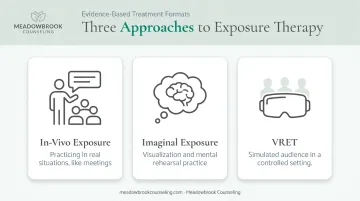
The Three Main Formats
- In-vivo exposure – speaking in real situations, such as a small meeting or a live audience
- Imaginal exposure – vividly visualizing the speaking scenario when real-life practice isn't feasible yet
- Virtual reality exposure (VRET) – using a simulated audience in a controlled, repeatable environment
Clinically, these formats fall under the broader treatment category for social anxiety disorder and specific phobias.
A randomized controlled trial published in the Journal of Consulting and Clinical Psychology followed 97 adults with social anxiety disorder and a primary fear of public speaking. Researchers compared VRET, in-vivo exposure group therapy, and a wait-list control. Both active treatments outperformed the wait list, and gains held at 12 months, with no meaningful difference between formats.
Why Exposure Therapy Is Used for Public Speaking Anxiety
Avoidance feels like relief in the moment. Skip the presentation, decline the toast, ask a coworker to run the meeting instead, and the anxiety drops immediately. That relief is exactly the problem.
Each time you avoid a speaking situation, your brain files away a lesson: that was dangerous, and avoiding it is what saved me. Over time, this cycle strengthens the fear rather than shrinking it. Exposure therapy interrupts that pattern by proving, through direct experience, that the outcome isn't as catastrophic as predicted.
This fear is also more common than most people assume. A survey of graduate medical trainees found that 17% of respondents reported anxiety symptoms specifically when speaking in front of others. The finding comes from a professional training sample rather than the general population, but it's still a meaningful signal in a high-performance setting.
Left untreated, this anxiety tends to compound:
- Avoided presentations at work, which can stall promotions or visibility
- Skipped classes or assignments requiring verbal participation
- Declined leadership roles that involve public communication
- A growing belief that speaking situations are unmanageable
Exposure-based approaches are considered clinical best practice for anxiety and phobias because they're grounded in decades of CBT research, not anecdotal "just get out there" advice. Public speaking specifically demands tolerance for physiological arousal (racing heart, shaky voice, sweating) while staying composed in real time. Knowledge and preparation help with content, but they don't retrain the body's threat response. That's the piece exposure therapy targets.
How Exposure Therapy Works (The Process)
At Meadowbrook Counseling, the therapist and client collaboratively identify speaking-related triggers, build a ranked hierarchy of feared scenarios, and work through it at a pace the client can actually tolerate. Nobody gets thrown into a keynote speech on day one.
Anxiety is typically tracked using a Subjective Units of Distress Scale (SUDS), where 0 means calm and 100 means panic-level distress. This gives both therapist and client a shared language for pacing exposure and deciding when to move forward.
As sessions progress, most clients notice:
- Reduced physiological reactivity (less racing heart, less shakiness)
- More balanced thoughts about speaking ("I can handle this" replacing "this will be a disaster")
- Increased confidence built through repeated, real success, not reassurance alone
Step 1: Building the Fear Hierarchy
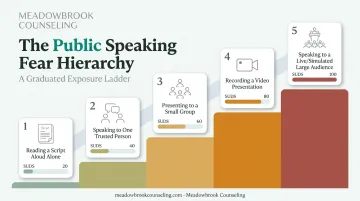
The client and therapist list speaking situations from mildly uncomfortable to highly distressing. A typical hierarchy might look like this:
- Reading a script aloud, alone
- Speaking to one trusted person
- Presenting to a small group
- Recording a video presentation
- Speaking to a live or simulated large audience
Step 2: Gradual, Repeated Exposure
Sessions move through the hierarchy one step at a time, and the therapist never rushes toward the hardest scenario. Each level gets repeated until the SUDS rating consistently drops before advancing. This often means several sessions at "speaking to a small group" before ever tackling a larger audience.
Step 3: Processing and Reinforcement
After each exposure, the therapist debriefs with the client: What did you predict would happen? What actually happened? This cognitive reframing is where the real learning locks in.
Grounding or breathing techniques are often used alongside exposure to help clients stay present rather than dissociate or shut down mid-exercise. Repetition continues until the fear response consistently decreases.
Common Misconceptions and When Exposure Therapy May Not Be Right
A few myths tend to get in the way of people starting treatment.
"Exposure therapy just means practice more speaking." Not quite. Toastmasters and coaching build comfort and skill through repetition, which helps, but they lack the clinical structure, distress monitoring, and hierarchy-based pacing that define therapist-guided exposure. Exposure therapy is monitored and adjusted session to session based on the client's actual fear response.
"One session should fix it." Fear responses built over years don't unwind in a single meeting. Clinical guidelines describe CBT for social anxiety commonly running 14 to 16 weekly sessions over roughly 3 to 4 months, though shorter formats can work for milder cases. Progress is graded and cumulative, not instant.
"Reduced anxiety means the fear is gone." More realistic goal: symptom management, not a total cure. Many people who complete exposure therapy still feel some nerves before speaking. What changes is their ability to function and perform despite those nerves.
When exposure alone may not be the right starting point:
- Fear rooted in a specific traumatic speaking experience (public humiliation, a panic attack witnessed by others) may need trauma-focused work first
- Significant dissociation or unprocessed trauma symptoms can interfere with a person's ability to engage in graded exposure safely
- In these cases, approaches like EMDR, which many Meadowbrook Counseling therapists are trained in, are sometimes used before, or alongside, exposure-based work
Getting Professional Support for Public Speaking Anxiety
Exposure therapy works best when a licensed therapist paces it, adjusts it to your specific triggers, and knows when to pull back or push forward. Self-directed exposure can help with mild nervousness, but persistent or severe anxiety benefits from clinical oversight.
That level of guidance is exactly what you'll find at Meadowbrook Counseling, where our therapists bring specialized training in evidence-based anxiety treatments that translate directly to speaking and performance-related anxiety. Our practice spans multiple locations across Utah, Washington, Arizona, Wisconsin, Massachusetts, Texas, and beyond, with both in-person and telehealth options depending on location and therapist availability.

Before your first session, our team verifies your insurance benefits so there are no surprises about coverage once treatment starts. We work with plans including:
- Aetna
- Cigna
- UnitedHealthcare
- Medicaid
- Medicare Advantage
- TriCare
If public speaking anxiety has been holding you back at work, school, or in daily life, reach out to Meadowbrook Counseling for a personalized treatment plan rather than trying to white-knuckle through it alone.
Frequently Asked Questions
How to get over public speaking anxiety?
Effective approaches combine preparation, gradual practice, and structured exposure to speaking situations. For persistent or severe anxiety, working with a therapist trained in exposure-based CBT typically produces more lasting results than self-practice alone.
Does exposure therapy work for public speaking?
Yes. It's a well-supported, evidence-based treatment that works through gradual habituation, teaching your nervous system that speaking situations aren't dangerous, rather than through avoidance or willpower.
How long does exposure therapy take to work for public speaking anxiety?
It varies by individual, but treatment commonly involves multiple sessions working through a fear hierarchy over several weeks to a few months. Some structured programs use as few as eight sessions; others take longer depending on severity.
Is exposure therapy the same as practicing with a group like Toastmasters?
No. Peer practice groups build comfort and public speaking skill, which is valuable, but they don't include the clinical structure, distress monitoring, or fear-response focus that defines therapist-guided exposure therapy.
Can I do exposure therapy on my own without a therapist?
Self-guided exposure can help with mild, situational nervousness. For more severe, persistent, or trauma-linked fear, professional guidance helps ensure the pacing and technique actually reduce anxiety instead of reinforcing it.
What's the difference between traditional exposure therapy and virtual reality exposure for public speaking?
VR exposure uses a simulated, controllable audience so you can practice repeatedly in a private setting. Traditional exposure uses real or imagined scenarios. Both follow the same gradual principle and produce comparable results.