
Toxic relationships don't end cleanly at the breakup. They chip away at trust, self-worth, and your ability to trust your own perceptions. That's why this kind of recovery often feels harder and slower than an ordinary split.
This guide covers how to recognize a toxic dynamic, why the psychological aftermath lingers, concrete steps to start healing now, and when working with a trauma-informed therapist can shorten the road back to yourself.
Key Takeaways
- Healing isn't linear — expect good days and setbacks as your nervous system recalibrates
- Boundaries, sometimes including no contact, are usually the first protective step
- Self-compassion and consistent self-care rebuild the self-worth that toxic dynamics erode
- You can heal on your own; repairing it requires mutual accountability and safety
- Trauma-informed therapy, like EMDR, can speed up recovery when self-help isn't enough
How to Tell if Your Relationship Was Toxic
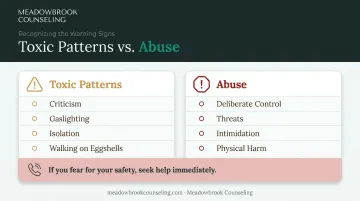
A toxic relationship is any pattern of behavior that consistently damages your emotional, mental, or physical wellbeing. This applies to romantic partners, family members, or friends. The key word is pattern — one bad fight doesn't make a relationship toxic, but a repeated cycle of harm does.
Common red flags include:
- Constant criticism or belittling, even over small things
- Controlling behavior around your time, money, or decisions
- Gaslighting — being told your memory or feelings aren't valid
- Walking on eggshells to avoid setting someone off
- Isolation from friends and family, gradually or all at once
- Feeling drained and anxious after time together, rather than supported
These patterns range in severity, which raises an important question: where does "toxic" end and "abuse" begin?
Toxic vs. Abusive: Why the Difference Matters
Toxic describes unhealthy patterns; abuse is a deliberate, ongoing pattern of power and control that can include threats, intimidation, or physical harm. If you fear for your safety, that distinction matters less than getting help immediately.
Contact the National Domestic Violence Hotline at 800-799-7233, or text START to 88788, before focusing on any longer-term healing work.
The Psychological Impact: Why Healing Takes Time
Living in a chronically stressful relationship keeps your body's stress-response system switched on. A National Institutes of Health study on couples found that a partner's ongoing stress was linked to flatter, less healthy cortisol patterns throughout the day.
That's a measurable biological footprint, and it's part of why anxiety, low mood, or PTSD-like symptoms can persist well after you've physically left.
Your Perceptions Take a Hit Too
Manipulation and gaslighting don't just hurt in the moment. Controlled memory studies have found that repeated pressure from a partner can increase acceptance of false information and lower confidence in your own recall.
Self-doubt after a toxic relationship is a documented effect of manipulation, not a sign that your judgment is broken.
Self-esteem erodes the same gradual way. Behavior you would have rejected on day one starts feeling normal by month twelve, simply because it arrived slowly, one small compromise at a time. That's why survivors often need permission to trust their own instincts again, especially amid the emotional turmoil that follows.
Emotions That Are Normal, Not Weakness
Early recovery often brings a confusing mix of feelings:
- Guilt over "letting it happen" or leaving
- Shame about staying as long as you did
- Grief for the good moments and the future you'd imagined
- Missing your former partner, even knowing the harm they caused
These reactions are survival responses, not weaknesses. Your nervous system needs deliberate time to downshift out of alert mode. There's no fixed deadline for that.
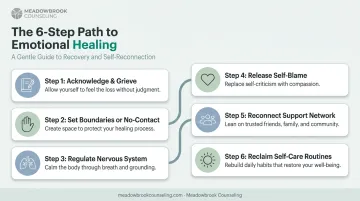
Steps to Begin Healing After a Toxic Relationship
Acknowledge What Happened and Let Yourself Grieve
Write down a factual, chronological account of what happened. Include specific incidents and how you felt in the moment. Not for anyone else, just for you. This counters self-doubt when your mind tries to rewrite the story as "not that bad." Grieving the good parts, and the hope you had for the relationship, is valid even when the relationship was harmful.
Set Firm Boundaries (or Go No-Contact)
Think of boundaries as psychological fencing, not punishment. A simple script: "I'm not available to discuss this. Please don't contact me about it again." This might mean muting their social media or asking mutual friends not to pass along messages. Full no-contact becomes necessary when a person repeatedly ignores boundaries or when contact itself feels destabilizing.
Regulate Your Nervous System
When anxiety spikes, try the 5-4-3-2-1 grounding technique: name 5 things you see, 4 you feel, 3 you hear, 2 you smell, 1 you taste. Pair it with slow breathing, in for four counts, out for six. Both redirect your body out of fight-or-flight and into the present moment. This combination works well before triggering moments, such as running into an ex.
Release Self-Blame and Practice Self-Compassion
Swap "What's wrong with me?" for "What did I need that I wasn't getting?" Toxic dynamics happen to people across every background, income level, and personality type. Compassionate curiosity replaces shame with understanding, which is far more useful for moving forward. A therapist trained in trauma-informed care can help you unpack these patterns without judgment.
Reconnect with Your Support Network
Isolation is a common toxic-relationship tactic, whether intentional or not. Rebuilding ties with friends and family you drifted from is one of the most protective things you can do. Start small: one coffee, one phone call, one honest conversation.
Reclaim Daily Self-Care Routines
Sleep, movement, and nutrition are foundational, not optional extras. Even light, regular exercise builds emotional resilience to stress, helping people bounce back faster after a stressful event, according to a PubMed Central-published study on exercise and stress recovery. Start with one habit you can sustain, not five you'll abandon by Friday.
Rebuilding Self-Trust, Identity, and Future Relationship Standards
Toxic relationships often shrink your world. Hobbies get dropped, opinions go unspoken, and parts of your personality quietly disappear to keep the peace. Rediscovering them is part of getting your identity back.
Relearning to trust your own intuition takes practice after someone repeatedly told you it was wrong. Start by noticing small gut feelings and testing whether they hold up, then trusting them a little more each time they do.
A useful exercise: build your own red flag / green flag list from what you lived through.
- Red flags: dismissing your feelings, controlling your time, punishing you for disagreement, or twisting the story so you're always at fault
- Green flags: taking accountability, respecting your "no," staying curious instead of defensive
This isn't a diagnostic checklist, just a personal reference for spotting healthy dynamics sooner next time.
That clarity naturally raises another question: can the relationship itself be healed? Your personal healing is always possible, regardless of what your ex does. Repairing the relationship is a separate matter, requiring mutual accountability and genuine safety, with both people actually willing to change, not just promising to.
While that larger question sits unresolved, your own growth doesn't have to wait. Try a daily wins practice: write down one thing you did each day that reflects who you're becoming. Small, consistent evidence rebuilds confidence faster than waiting for one big breakthrough.
When Professional Support Accelerates Healing
Self-help strategies work for a lot of people. But when intrusive memories, avoidance, or hyperarousal don't fade with time, trauma-informed treatment can help far more than pushing through alone.
EMDR (Eye Movement Desensitization and Reprocessing) helps the brain reprocess painful memories so they stop feeling as raw and immediate. It's one of the most researched approaches for trauma, and it often works faster than talk therapy alone for these specific symptoms.
Therapy also helps you spot recurring patterns, the types of partners, arguments, or roles you tend to fall into, so you're less likely to repeat them. And if you're considering reconciliation with a partner who wasn't abusive, couples counseling can offer a structured way to test whether real change is happening.
At Meadowbrook Counseling, this looks like:
- Personalized therapist matching based on your specific history and goals
- Access to EMDR-trained clinicians across multiple locations in Utah, Idaho, and other states
- Insurance verification support before your first session, so cost isn't a guessing game
- Both in-person and telehealth appointments, depending on what feels safer for you

Getting matched with the right therapist often makes the difference between healing slowly and healing with real support behind you.
Frequently Asked Questions
How to tell if your relationship is toxic?
Watch for persistent patterns like constant criticism, control, gaslighting, isolation, or feeling drained rather than supported. Occasional conflict is normal; a repeated pattern that damages your well-being is what defines toxicity.
Can a toxic relationship be healed?
Your personal healing is always possible, no matter what happens with the relationship. Repairing the relationship itself only works with mutual accountability, genuine safety, and both partners committed to real change.
How long does it take to heal from a toxic relationship?
Timelines vary widely based on how long the relationship lasted and how severe the dynamics were. Consistent self-care and professional support, like therapy, typically shorten recovery time compared to going it alone.
Is it normal to still miss a toxic ex?
Yes. Missing the good parts or grieving the future you'd hoped for is common and doesn't mean you should reach back out. It's part of grief, not a sign the relationship was healthy.
What type of therapy helps most after a toxic relationship?
EMDR, CBT, and trauma-informed individual therapy are all evidence-based options. Meadowbrook Counseling's therapists often combine approaches, such as EMDR with CBT or DBT, depending on your specific symptoms and goals.
Should I go no-contact with a toxic ex?
No-contact is often recommended, especially in abusive dynamics, because it removes ongoing activation and lets your nervous system settle. In co-parenting or family situations, limited, structured contact may be unavoidable instead.