Introduction
Hearing "your teen has depression" from a doctor or therapist can knock the wind out of you. The good news: this is one of the most treatable conditions in adolescent mental health.
That treatability matters, because depression among teens is far from rare. In 2024, 15.4% of U.S. adolescents ages 12-17, or roughly 3.8 million teens, experienced a major depressive episode, according to SAMHSA's National Survey on Drug Use and Health. Yet many of these teens never get help.
This guide breaks down the main evidence-based treatment options, how they differ, and how to figure out which approach fits your teen's specific situation.
Key Takeaways
- Depression affects millions of U.S. teens, but most never receive treatment
- Psychotherapy, medication, and combination care are the three main evidence-based paths
- CBT and family-based therapy are typically the first treatments clinicians recommend
- Medication works best alongside therapy, not alone, for moderate-to-severe cases
- The right approach depends on severity and safety concerns, not convenience
What Is Teen Depression Treatment?
Teen depression treatment is a structured combination of psychotherapy, medication, and lifestyle interventions designed to reduce depressive symptoms and help adolescents function again at school, at home, and with friends.
Evidence-based is the key phrase here. It means a treatment has been tested in clinical trials and shown to reliably reduce symptoms, not just anecdotally reported to help. This distinguishes proven approaches like cognitive behavioral therapy from unproven fads or supplements with no research backing.
Treatment is an ongoing, professionally guided process (not a single appointment or quick fix) that typically involves:
- Complete an initial evaluation to assess severity and safety
- Develop a tailored treatment plan combining therapy, medication, or both
- Attend regular check-ins to track progress
- Adjust the plan if the current approach isn't working
Successful treatment depends on this partnership between your teen, your family, and a qualified provider.
Why Is Evidence-Based Treatment Important for Teen Depression?
Depression that goes untreated rarely stays static. It tends to spread into other areas of a teen's life: grades slip, friendships fray, and family relationships get strained.
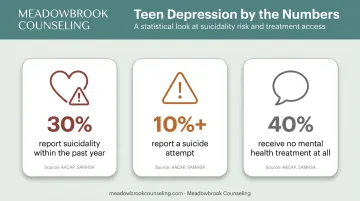
The stakes are higher than many parents realize. According to the American Academy of Child and Adolescent Psychiatry's clinical guideline, among adolescents with major depressive disorder:
- Nearly 30% report some form of suicidality within the past year
- More than 10% report a suicide attempt
That's not a statistic to sit on.
The treatment gap makes this worse: SAMHSA data shows that roughly 40% of adolescents with a major depressive episode receive no mental health treatment at all. That's a lot of teens navigating a serious illness alone.
Given that gap, "wait and see" isn't as neutral as it sounds. It can work for very mild, brief symptoms, but it can also let a treatable condition drag on for months. Evidence-based care, by contrast, has measurable, replicated outcomes in clinical trials — a difference that matters when your teen's wellbeing is on the line.
Types of Teen Depression Treatment
Teen depression treatment isn't one-size-fits-all. The right approach depends on how severe the symptoms are, what's driving them, and what your teen and family can realistically commit to.
Most clinicians don't pick just one method and stop there. Especially for moderate-to-severe cases, treatments are often layered together rather than used in isolation.
Psychotherapy (Talk Therapy)
Psychotherapy involves structured sessions, one-on-one or with family, led by a licensed therapist. The goal is to address the thought patterns, relationships, and behaviors feeding the depression.
Four modalities dominate the evidence base:
- Cognitive Behavioral Therapy (CBT): Targets negative thought patterns and replaces them with more accurate, workable ones
- Interpersonal Therapy (IPT): Focuses on improving relationships and communication that may be fueling low mood
- Dialectical Behavior Therapy (DBT): Builds emotional regulation skills, especially useful when self-harm or intense mood swings are present
- Family therapy: Works on family dynamics that may be contributing to or worsening symptoms
Unlike medication, psychotherapy doesn't alter brain chemistry directly. It builds skills and insight instead. That makes it non-pharmacological, meaning no drug side effects to manage.
Psychotherapy works best for:
- Mild-to-moderate depression
- Teens motivated to build long-term coping tools
- Families whose dynamics may be part of the problem
Key strengths: It's the first-line recommendation from major clinical guidelines, including the AACAP and APA, and it teaches skills that reduce the odds of relapse down the road.
The trade-off? Results take time. Expect 6-16+ weekly sessions before seeing meaningful change.
Outcomes also depend heavily on finding a therapist your teen actually clicks with, and a mismatch can stall progress before it starts. Practices that offer therapist matching, such as Meadowbrook Counseling's intake process, help families connect with a clinician whose specialty and style fit their teen.
Medication (Antidepressants)
Antidepressants, primarily SSRIs, work by adjusting neurotransmitter levels like serotonin to help regulate mood. Only two SSRIs carry FDA approval specifically for treating depression in adolescents:
- Fluoxetine (Prozac): approved for pediatric MDD, ages 8 and older
- Escitalopram (Lexapro): approved for pediatric MDD, ages 12 and older
This is a biological intervention, not a skills-based one. It requires a prescriber's ongoing monitoring rather than weekly talk sessions.
Medication tends to be reserved for:
- Moderate-to-severe depression
- Cases where therapy alone hasn't produced enough improvement
The upside: Medication can produce noticeable symptom relief, particularly when combined with psychotherapy.
The catch: All antidepressants carry an FDA black-box warning about increased suicidal thoughts and behaviors in patients under 25. FDA's pooled analysis found 14 additional cases of suicidal thoughts or behaviors per 1,000 treated patients under 18, compared to placebo, in short-term trials.
It also takes 4-6 weeks to reach full effect and requires close medical follow-up, especially in the first few months.
Combination and Advanced Care
For teens with more severe or treatment-resistant depression, combining approaches often beats using just one. Combination treatment typically pairs psychotherapy, usually CBT, with medication. For the most serious or unresponsive cases, options escalate to intensive outpatient programs, hospitalization, or neuromodulation like transcranial magnetic stimulation (TMS).
The data backs this up. In the landmark Treatment for Adolescents With Depression Study (TADS), a 12-week trial of 439 adolescents with major depressive disorder, response rates were:
| Treatment | Response Rate |
|---|---|
| Fluoxetine + CBT | 71.0% |
| Fluoxetine alone | 60.6% |
| CBT alone | 43.2% |
| Placebo | 34.8% |
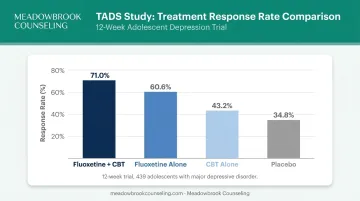
Combination treatment beat every other group by addressing both the biological and psychological sides of depression at once, rather than simply adding intensity for its own sake.
Best suited for: Teens with severe symptoms, safety concerns, or those who haven't responded to standard first-line care.
The trade-off: More resources, more time, potentially more cost. And newer tools like TMS have a smaller evidence base in adolescents. A 2022 review found promising results in small, uncontrolled studies, but the largest randomized sham-controlled trial (103 adolescents) found no significant advantage over sham treatment. Promising, but not yet as proven as CBT or SSRIs.
How to Choose the Right Treatment Approach for a Teen
Choosing the right treatment means matching your teen's specific symptoms, severity, and circumstances, not just picking whatever's fastest or most convenient.
Factors worth weighing:
- Severity and duration: Mild, moderate, or severe symptoms, and how long they've been going on
- Safety concerns: Self-harm or suicidal thoughts may require more immediate or intensive care
- Your teen's openness: Some teens engage more readily with talk therapy; others may be more receptive to medication
- Family dynamics: If family conflict is a contributing factor, family therapy may address root causes directly
- Practical logistics: Insurance coverage, provider availability, and location all matter
That last point trips up a lot of families. Coverage and provider specialties vary widely. That's why practices offering upfront insurance verification and a range of provider specialties, such as Meadowbrook Counseling, can simplify this step considerably.
What to Check Before Finalizing a Treatment Plan
Before committing to a plan, run through this checklist:
- Don't jump to intensive options too fast. If symptoms are mild, therapy alone may be enough. Save medication or intensive programs for cases that need them.
- Ask detailed questions about medication risks. Don't skip past the FDA black-box warning. Ask the prescriber how they'll monitor for side effects.
- Confirm there's a way to track progress. A solid plan includes checkpoints to reassess if the approach isn't working after a reasonable trial period, usually a few weeks to a couple of months.
- Verify the provider's specific experience with adolescent depression. General counseling experience isn't the same as training in teen-specific presentations of depression. Ask directly.
Conclusion
Teen depression is common, but it's also genuinely treatable. Whether the path is psychotherapy, medication, combination care, or something more intensive, real recovery is possible with the right support.
No single treatment fits every teen. Understanding how these options differ puts families in a stronger position to make informed decisions alongside a qualified professional. That beats guesswork based on what worked for someone else's kid.
If you're not sure where to start, a professional evaluation is the most useful next step. Meadowbrook Counseling's intake team matches teens with therapists suited to their needs, whether that means EMDR, family therapy, or another approach, and verifies insurance benefits before the first session.
Frequently Asked Questions
How do I deal with depression in teens?
Start with open, non-judgmental communication and seek a professional evaluation as soon as possible. Parental support paired with evidence-based therapy tends to produce better outcomes than either approach alone.
Why is my 16-year-old son depressed?
Depression usually stems from a mix of genetic, hormonal, and environmental factors, such as academic pressure or family stress. A professional evaluation can pinpoint which factors apply to his situation.
What are therapy activities for teens with depression?
Common activities include mood diaries or thought records used in CBT, role-playing communication scenarios in IPT, and scheduling enjoyable activities to rebuild engagement with daily life. These build practical skills, not just talk.
What is the first-line treatment for teen depression?
Psychotherapy, particularly CBT, is recommended first for mild-to-moderate cases. Medication gets added for moderate-to-severe depression, per major clinical guidelines from the AACAP and APA.
Are antidepressants safe for teenagers?
FDA-approved SSRIs like Prozac and Lexapro are considered safe under medical supervision. They carry a black-box warning about increased suicidal thoughts in patients under 25, requiring close monitoring early in treatment.
How long does teen depression treatment take to work?
Psychotherapy often shows improvement within 6-16 weeks of consistent sessions, while medication typically takes several weeks to reach full effect. Sticking with the treatment plan matters more than which option you start with.