

Introduction
You're doing the dishes when a credit card statement slides out of a stack of mail. It's not yours. It's not one you knew about. Suddenly you're staring at months of charges your partner never mentioned.
That gut-punch feeling? It's real, and it's more common than most couples admit.
Financial infidelity rarely gets talked about at dinner parties, but therapists see it constantly. In a 2021 NEFE poll, 43% of adults who'd combined finances with a partner admitted to some form of financial deception.
This guide breaks down what financial infidelity actually looks like, why it happens, and how couples rebuild trust after the secret comes out.
Key Takeaways
- Financial infidelity means deliberately hiding money behavior, not honest mistakes
- Nearly 43% of coupled adults admit to financial deception, research shows
- Recovery hinges on full disclosure, understanding root causes, and ongoing transparency
- Many couples benefit from a Gottman Method or EFT-trained therapist
What Is Financial Infidelity?
Financial infidelity is the deliberate concealment or dishonesty about money from a romantic partner. It's different from forgetting to log a coffee run or misremembering a bill's due date. The defining trait is intent: hiding something you know your partner would object to.
That intent-based definition echoes formal research. Garbinsky, Gladstone, Nikolova, and Olson studied the pattern across ten lab experiments and real bank-account data. They define it as engaging in financial behavior you expect your partner to disapprove of, then choosing not to disclose it.
Common examples include:
- Opening a secret bank account or credit card
- Hiding debt, whether from student loans, gambling, or shopping
- Lending money to family members without mentioning it
- Making major purchases and downplaying the cost
- Taking out a loan in a partner's name without consent
The Severity Spectrum
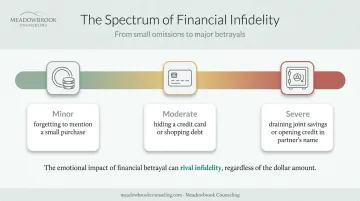
Not all financial infidelity carries the same weight. Forgetting to mention a $40 over-budget purchase sits at one end. Draining a shared savings account or opening credit in your partner's name without permission sits at the other.
Both erode trust, but the recovery path looks different depending on where the behavior falls on that spectrum.
Here's the part that surprises people: researchers have found financial secrets can carry emotional weight similar to physical or sexual infidelity. The dollar amount matters far less than what the secrecy reveals about honesty in the relationship as a whole.
Why Does Financial Infidelity Happen?
Money secrecy rarely comes from nowhere. It usually grows out of fear, mismatched values, or deeper relationship strain.
Common motivations include:
- Fear of judgment. In the NEFE survey, 34% of people who admitted financial deception said they were avoiding their partner's disapproval.
- Desire for privacy. Another 38% believed some financial matters should stay private, even from a spouse.
- Desire for autonomy. A separate CreditCards.com poll found 30% wanted financial independence and 25% cited embarrassment as their reason for hiding money.
- Conflict avoidance. Hiding a purchase feels easier than having another argument about spending.
Money Scripts From Childhood
The way we handle money is often learned, not chosen. Research by financial psychologists Klontz and Britt found that people raised with "money-status" beliefs (linking spending to self-worth) were more likely to lie to a spouse about purchases. Someone taught that a bigger paycheck equals a bigger person, for example, may hide a bonus rather than risk feeling diminished. These beliefs form early and operate in the background of adult decisions, often without either partner noticing.
A Symptom, Not Just a Cause
These inherited money scripts don't operate in isolation; they interact with the dynamics of the relationship itself, and financial infidelity is frequently a symptom of something bigger. Power imbalances, feeling controlled, or existing mistrust in the relationship can all push someone toward secrecy instead of honesty. Addressing only the hidden credit card without addressing what's underneath rarely fixes the real problem.
The Emotional and Financial Toll It Takes
Discovering financial infidelity doesn't just create a budgeting problem. It creates a trust problem, and that kind of wound hits hard.
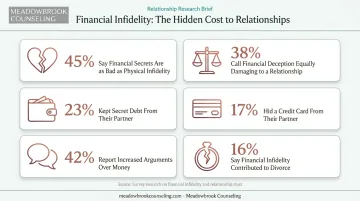
The betrayed partner often experiences anger, grief, and a shaken sense of safety, reactions that mirror discovering an affair. A 2025 Bankrate survey backs this up: 45% of adults in committed relationships said financial secrets were at least as bad as physical infidelity. Another 38% called them equally damaging, and 7% said they were worse.
The Financial Fallout
The practical consequences stack up too:
- 23% of adults in committed relationships have kept secret debt
- 17% have kept a hidden credit card
- Among couples who said deception affected their relationship, 42% reported increased arguments, 32% reported reduced trust, and 16% reported it contributed to divorce
Why One Secret Rarely Stays Contained
Here's what makes financial infidelity particularly corrosive: discovering one hidden account often makes the betrayed partner question everything else. Was the "business trip" real? Is anything else being hidden? That spiral compounds the damage well beyond the original secret, touching intimacy and communication in ways that have nothing to do with money.
How to Recover from Financial Infidelity: A Step-by-Step Guide
Recovery from financial infidelity rarely happens after one hard conversation; it's a gradual process that works best when both partners commit fully.
Acknowledge the Betrayal and Validate the Hurt
The betrayed partner needs room to feel angry, disappointed, or blindsided without being told to "get over it." Rushing this step almost always backfires, so give it time before jumping to solutions.
Commit to Full and Ongoing Financial Disclosure
Full disclosure means everything is on the table:
- Bank and credit card statements
- Credit reports from all three bureaus
- Outstanding debts, including informal loans
- Shared access to all accounts going forward
One disclosure conversation isn't enough, so the Journal of Financial Therapy recommends a joint balance sheet and budget that both partners can review together, turning transparency into an ongoing habit, not a one-time confession.
Explore the Root Cause Together
Ask why the secrecy happened, not just what happened. Was it fear of judgment, a money script from childhood, or a need for control in a relationship that felt unbalanced? Understanding the "why" prevents the same pattern from resurfacing under a different disguise.
Establish Regular, Low-Conflict Money Check-Ins
Schedule a recurring time, weekly or monthly, to review spending and progress together. Frame it as "us against the problem," not partner against partner. Twenty minutes on a Sunday beats an ambush conversation after a bad day.
Rebuild Trust Through Consistent, Transparent Actions
Trust rebuilds through repetition, not grand gestures, and these practical habits show how:
- Shared account access with no hidden logins
- Tracking spending together using a shared app or spreadsheet
- Acknowledging small wins, like three months of full transparency
Recovery isn't linear, so expect setbacks, moments of doubt, and the need for repeated reassurance. Consistency over months matters more than perfection in any single week.
When to Seek Professional Support
Some couples work through financial infidelity on their own. Others need a neutral third party, and there's no shame in that.
Signs it's time to bring in a therapist:
- The deception has happened more than once
- Money conversations escalate into criticism, defensiveness, or shutdown
- You're stuck in the same argument without progress
- One or both partners can't move past the betrayal alone
A couples therapist helps structure honest conversations about money without letting them spiral into blame. They also help uncover what's really driving the behavior, whether that's anxiety, control, or old family patterns around spending.
At Meadowbrook Counseling, couples work with therapists trained in approaches like the Gottman Method and Emotionally Focused Therapy (EFT), both built specifically around rebuilding trust and improving communication after a betrayal. These frameworks give couples a structured way to rebuild trust step by step, rather than expecting them to move past betrayal on willpower alone.

A few practical notes if you're considering therapy:
- Meadowbrook offers both in-person appointments (across Utah, Washington, Arizona, Massachusetts, and other states) and telehealth options
- Recovery works best when both partners attend sessions, not just the partner who kept the secret
- Meadowbrook's team helps verify insurance benefits before your first session, so cost concerns don't add stress to an already difficult time
Frequently Asked Questions
What qualifies as financial infidelity?
Financial infidelity is the deliberate concealment of money behavior your partner would disapprove of, such as secret accounts, hidden debt, or undisclosed spending. Honestly forgetting to mention a purchase doesn't count.
Can couples recover from financial infidelity?
Yes. Recovery is possible through honest disclosure, ongoing transparency, and often professional support. It takes time, and setbacks along the way are normal.
How do you cope with financial infidelity?
Let yourself feel the anger or hurt without rushing past it. Avoid blame-heavy conversations, and consider structured support like the couples counseling offered at Meadowbrook Counseling to guide the process.
Is financial infidelity as serious as cheating?
Research suggests it can carry a similarly damaging emotional impact, since both involve broken trust and hidden truths. The betrayal often feels just as personal.
How common is financial infidelity?
National surveys estimate that 32% to 43% of coupled adults have committed some form of financial deception, depending on how the behavior is measured.
Should you forgive financial infidelity?
Forgiveness is personal and depends on the severity of the secrecy, the partner's willingness to change, and whether trust can realistically be rebuilt. There's no universal timeline for this decision.