
Introduction
One minute, your teenager slams their bedroom door so hard the pictures rattle. Twenty minutes later, they're curled up next to you on the couch, laughing at an old family video like nothing happened.
If this whiplash sounds familiar, you're not doing anything wrong. Many parents describe this exact push-pull: communication that feels one-word-answer thin, safety worries that keep them up at night, and a quiet grief for the closeness they used to share with their kid.
Here's the reassuring part: there's real science behind what's happening in your teen's brain and behavior. This guide walks through that science, practical strategies that actually work, how to handle specific tough moments, and when it's time to bring in professional support.
Key Takeaways
- Teen brain development, not defiance, drives most mood swings and impulsive choices
- Consistent boundaries paired with real conversation build more trust than strict control alone
- Early-to-mid adolescence is genuinely harder for many families, and that's temporary
- Family therapy can strengthen your relationship, not just address a problem
Understanding the Teenage Years: What's Really Going On
Your teenager isn't trying to make your life difficult. Their brain is still under construction.
The prefrontal cortex, the region responsible for impulse control, planning, and weighing consequences, is one of the last parts of the brain to mature. According to the National Institute of Mental Health, this development continues into the mid-to-late 20s.
Meanwhile, the brain's reward and social-processing systems ramp up earlier. That's part of why peer opinions can suddenly feel more urgent than parental ones.
A few other things are happening simultaneously:
- Hormonal shifts intensify emotional reactivity, so a minor disagreement can feel catastrophic to your teen
- Identity formation pushes them to test who they are outside your household
- Independence-seeking is a normal developmental task, even when it looks like rebellion
- Peer influence grows, but parental influence doesn't vanish. It just changes shape, from direct instruction to modeling and trusted guidance
None of this means teens are incapable of good decisions. It means their decision-making system and their reward system are on different developmental timelines.
Which Age Is Hardest to Parent?
Many parents point to ages 13 to 15 as the roughest stretch, and there's some truth behind that feeling. Some studies on parent-child conflict suggest that while the frequency of arguments tends to decline as adolescence progresses, the emotional intensity of those disagreements can actually increase in early-to-middle adolescence.
In other words: fewer fights, but the fights that do happen might feel bigger.
There's no single scientifically "proven" hardest age. What the evidence does support is this: difficulty often peaks in early adolescence and eases as teens mature, especially when parents stay engaged, keep communication open, and hold steady boundaries. If you're in the thick of it right now, that's not a permanent state.
Common Challenges Parents of Teens Face
Most families cycle through a familiar set of struggles. Recognizing the pattern helps you respond instead of react.
- Emotional outbursts and mood swings: tied directly to the brain and hormone changes above, plus academic pressure and social stress
- Behavioral testing and limit-pushing: usually a search for autonomy, not defiance for its own sake
- Peer pressure and social media influence: comparison culture and fear of missing out can drive risky decisions
- Communication breakdowns: secrecy, one-word answers, and constant screen time create emotional distance
- Risky or safety-related behaviors: staying out late, minor rule-breaking, or experimentation with substances or relationships
Social media deserves a closer look. A 2022 Pew Research survey found:
- 38% of teens felt overwhelmed by social-media drama
- 31% felt excluded by friends
- 29% felt pressure to post content that would get likes
- 23% felt worse about their own lives because of it
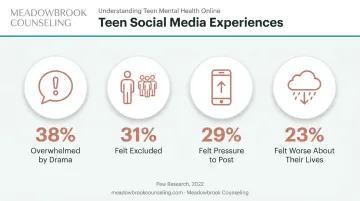
This goes beyond simple screen time. Your teen manages a steady stream of comparison and social evaluation every day. Rather than counting minutes on the phone, ask about exclusion, pressure, and how a specific app made them feel that day.
These challenges set the stage for the safety-related situations we'll cover shortly, but first, let's talk about what actually helps.
Practical Strategies and Tips for Parenting Teens
Communication and Active Listening
Teens shut down when they feel judged or lectured. They open up when they feel heard.
Try these shifts:
- Ask open-ended questions ("What was that like for you?") instead of yes/no ones
- Use reflective listening: repeat back what you heard before responding
- Validate emotions even when you disagree with the conclusion ("I get why that felt unfair" doesn't mean you're changing the rule)
Validation means acknowledging a feeling, not agreeing with the conclusion behind it. That distinction alone can defuse a lot of arguments before they start.
Setting Boundaries That Actually Work
Boundaries work best when they're clear, consistent, and tied to natural consequences rather than arbitrary punishment.
- State the rule and the reason behind it once, without repeating it five times
- Let consequences follow logically (missed curfew means earlier curfew next time, not a confiscated phone for a week)
- Involve your teen in creating some rules. A teen who helped set the curfew is more likely to respect it
- Stay consistent across situations: flexible enforcement teaches teens that rules are negotiable
This builds rules your teen has a stake in following while keeping structure intact.
The 7-7-7 Rule Explained
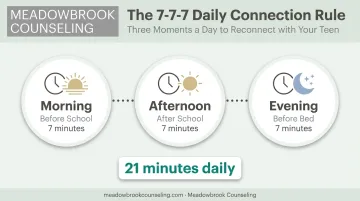
The 7-7-7 rule is a simple daily connection habit that's gained traction among parents. It breaks down to 7 minutes of focused one-on-one time before school, 7 minutes after school, and 7 minutes before bed—21 minutes total per day.
It's not a clinically validated protocol backed by a specific study. Think of it as a practical structure for staying connected during a stage when teens naturally pull away.
A practical example: instead of asking "How was school?" during the after-school check-in, ask about one specific thing, like a class or a friend. Then sit with your teen for those seven minutes and just listen. No advice, no follow-up interrogation, just presence.
Building Trust Through Independence
Trust builds in both directions. Gradually increasing privileges based on demonstrated responsibility gives teens room to prove themselves.
- Start small: a later curfew after a pattern of on-time returns
- Expand access (driving alone, unsupervised hangouts) as responsibility is shown
- Roll back privileges calmly when trust is broken, then rebuild the same way
This approach teaches accountability without turning every privilege into a battle.
Handling Specific Situations: When Rules Get Broken
Say your 17-year-old stays out all night with no explanation. Your instinct might be to unleash every consequence you can think of the second they walk through the door. Resist it.
Guidance from the American Academy of Pediatrics, via HealthyChildren.org, recommends a different order of operations:
- Express relief first. Let your teen know you were worried and you're glad they're safe
- Postpone the serious conversation until morning. A 2 a.m. confrontation rarely goes well for anyone
- Ask what happened before deciding anything. Did plans change? Did they lose track of time? Did they try to reach you?
- Set consequences tied to trust and safety, not blanket punishment. Rolling privileges back to a previous, more supervised level teaches cause-and-effect better than an unrelated punishment does
That said, one missed curfew is different from a pattern. Watch for red flags that suggest something deeper is going on:
| Warning sign | What it might indicate |
|---|---|
| Repeated substance use alongside mood changes | Substance use concern |
| Withdrawal, major sleep or appetite changes | Mental health struggle |
| Secrecy about a partner, controlling behavior from a partner | Unsafe relationship |
| Sudden drop in grades or daily functioning | Underlying stress or crisis |
A single rough night calls for a calm conversation. A pattern calls for closer attention, and possibly outside help. A licensed therapist who specializes in teen counseling, like those at Meadowbrook Counseling, can help you and your teen understand what's driving the behavior and rebuild trust from there.
When to Seek Professional Support
Some struggles resolve with time and consistency. Others need more support than a family can provide alone, and getting that support early is a proactive, smart step for your family.
Signs it may be time to reach out:
- Conflict that keeps escalating instead of settling
- Withdrawal from family, friends, or activities they used to enjoy
- Sudden behavior changes that last weeks, not days
- Signs of anxiety, depression, or persistent low mood
Family therapy and parent coaching give teens and parents shared tools, plus a neutral space where communication can actually improve instead of repeating the same fight.
Research generally favors approaches that involve parents alongside teens, though the right fit depends on the specific concern being treated.
At Meadowbrook Counseling, therapists work with teens and families using evidence-based approaches such as EMDR, trauma-informed care, CBT, and DBT, matched to what your family actually needs rather than a one-size-fits-all program.

With locations across Utah, Idaho, Washington, Arizona, Wisconsin, Massachusetts, Florida, Colorado, and Texas, plus telehealth options, care is designed to fit real schedules.
Before your first session, Meadowbrook's team can help verify your insurance benefits, so you know what's covered before you walk in the door. Reaching out early, before a pattern turns into a crisis, tends to make the biggest difference.
Frequently Asked Questions
My 17-year-old is staying out all night. What should I do?
Start by expressing relief that they're safe, and save the serious conversation for the next morning. Once you've both calmed down, ask what happened and set consequences tied to trust and safety, not blanket punishment.
What are some good tips for parents of teenagers?
Focus on active listening and open-ended questions, keep boundaries consistent, and give your teen chances to earn independence through demonstrated responsibility. Small daily connection moments matter more than long lectures.
What is the hardest age to parent a teenager?
Many parents find ages 13 to 15 particularly challenging, as emotional intensity during conflicts can increase even as arguments become less frequent. This difficulty typically eases as teens mature and parents stay consistent.
What is the 7-7-7 rule for parents?
It's a daily connection habit: 7 minutes of focused, one-on-one time before school, 7 minutes after school, and 7 minutes before bed. It's meant to build consistent connection, not to be a clinically proven formula.
How can I improve communication with my teenager?
Use open-ended questions instead of yes/no ones, and practice reflective listening by repeating back what you hear. Validate their feelings even when you don't agree with their conclusion.
When should I consider therapy for my teen or family?
Consider it if conflict keeps escalating, your teen withdraws from people they used to enjoy being around, or you notice signs of anxiety or depression lasting several weeks. Early support, such as teen counseling at Meadowbrook Counseling, often prevents bigger issues down the road.