

Former U.S. Surgeon General Dr. Vivek Murthy's 2023 advisory, Our Epidemic of Loneliness and Isolation, reports that roughly half of U.S. adults experience loneliness. That's not a fringe issue. It's a widespread pattern with real consequences for mental and physical health.
This article isn't about vague reassurances that "talking helps." It breaks down the specific mechanisms through which therapy changes loneliness: the thought patterns it targets, the wounds it uncovers, and the skills it builds.
Key Takeaways
- Therapy addresses loneliness's underlying causes, including thought patterns, trauma, and attachment wounds
- CBT-based interventions outperform social-only strategies in large-scale studies
- Untreated chronic loneliness raises the risk of depression, anxiety, and physical health decline
- Consistency and the right therapist match drive better results, especially paired with real-world social practice
What Is Therapy for Loneliness?
Therapy for loneliness is a structured, confidential process where a licensed clinician helps you understand and shift the thoughts, behaviors, and past experiences fueling your sense of disconnection.
Depending on what's driving the isolation, this might happen through:
- Individual therapy: one-on-one work exploring personal patterns
- Group therapy: practicing connection in a supportive, shared setting
- Specialized modalities: such as CBT for thought patterns or EMDR for trauma-related disconnection
Therapy differs from friendship and from simply "talking about feelings." Its purpose is rebuilding your capacity for genuine connection and self-trust.
Loneliness vs. Social Isolation
These terms get used interchangeably, but they're distinct:
| Term | Definition |
|---|---|
| Loneliness | A subjective feeling of being disconnected, even with people around |
| Social isolation | An objective, measurable lack of contact or relationships |
You can be socially isolated without feeling lonely, and you can feel intensely lonely in a crowded room. Therapy can address both, but the approach differs depending on which one you're facing.
Key Ways Therapy Helps with Loneliness and Isolation
The mechanisms below produce measurable shifts in thinking, behavior, and health, not abstract comfort. A major 2025 meta-analysis published in American Psychologist, reviewing 280 studies and more than 30,000 participants, found that psychological interventions like CBT produced the strongest short-term reductions in loneliness among the categories studied, outperforming social-support-only strategies.
Reframing Negative Thought Patterns That Fuel Isolation
Lonely individuals often develop automatic assumptions that steer their behavior. "Others will reject me." "I'm too much." "Nobody wants to hear from me first." These thoughts feel factual, but they're usually distorted, and they drive avoidance long before any actual rejection happens.
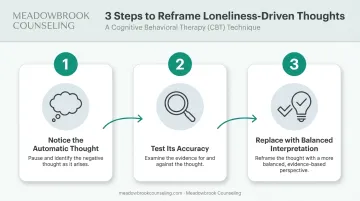
Cognitive behavioral therapy (CBT) helps clients:
- Notice the automatic thought the moment it appears, rather than letting it run unchecked
- Test its accuracy against real evidence instead of assumption
- Replace it with a more balanced interpretation that doesn't default to worst-case thinking
In the same 2025 meta-analysis, psychological interventions produced an estimated effect size of -0.59, notably larger than social-support interventions alone (-0.32). That gap matters. It suggests that simply creating more opportunities for contact isn't enough if someone's internal narrative keeps them from taking advantage of it.
This approach matters most for people whose loneliness stems from rejection sensitivity, social anxiety, or fear of vulnerability, not a genuine lack of opportunity.
Uncovering the Root Causes Behind Chronic Loneliness
For some clients, loneliness isn't about a thin social calendar. It's rooted in early attachment wounds, unresolved trauma, or grief that never got processed. These experiences can leave someone guarded in present-day relationships, even when people show up willing to connect.
EMDR (Eye Movement Desensitization and Reprocessing) helps clients process the past experiences that keep them on high alert in relationships. Instead of staying stuck reacting to old wounds, clients work through the memory itself, so it stops dictating present behavior.
At Meadowbrook Counseling, EMDR-certified clinicians including Rosario Toral work with clients whose isolation traces back to grief or trauma rather than a lack of social access. Rosario combines EMDR with CBT and solutions-focused approaches, applying a trauma-informed lens that treats each client's experience of loss as unique rather than following a one-size-fits-all script.
This work typically improves:
- Reduced hypervigilance in relationships
- Greater capacity for trust and intimacy
- Less reliance on avoidance as a default coping strategy
This path works best for chronic, long-standing loneliness, especially when linked to childhood neglect, past betrayal, or bereavement that was never fully grieved.
Building Practical Interpersonal Skills and a Support System
Therapy also functions as a low-stakes rehearsal space. Clients can rehearse vulnerability with a new friend or practice setting a boundary with a family member in session first, where the stakes are lower and the feedback is immediate.
Therapists help by:
- Guiding clients toward specific, achievable social goals rather than vague intentions like "be more social"
- Checking in on progress between sessions to build accountability
- Helping clients rehearse difficult conversations before they happen in real life
Research on CBT for loneliness shows measurable results whether delivered in person or through structured digital programs. One internet-based CBT trial found a between-group effect size of 0.77 after just eight weeks, with improvements sustained at a two-year follow-up. What matters across formats is regular, structured practice, not the delivery method itself.
This kind of skill-building proves especially valuable during major life transitions, such as retirement, relocation, new parenthood, or divorce, when existing social networks disrupt suddenly and old routines no longer apply.
What Happens When Loneliness Goes Untreated
Loneliness left unaddressed rarely stays static. It tends to compound.
- Mental health risk climbs. Adults who report frequent loneliness face higher odds of depression, along with elevated risk for anxiety and substance use as a coping mechanism.
- Physical health suffers. Chronic loneliness raises inflammation and cardiovascular strain, and the 2023 Surgeon General's advisory on social connection links it to health risks comparable to smoking 15 cigarettes a day.
- The cycle deepens itself. Withdrawal breeds more withdrawal. The longer someone stays isolated, the harder reconnection feels, which drives further retreat.
- Cognitive decline risk rises in older adults. A 2024 meta-analysis of 600,000 people across 21 samples linked loneliness to a 30% higher risk of dementia and a 39% higher risk of Alzheimer's disease.
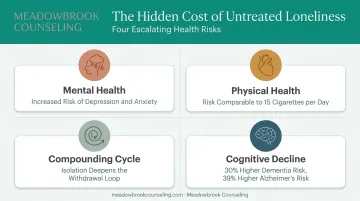
None of this means loneliness guarantees these outcomes, but the risk curve bends upward the longer it goes unaddressed. That's the case for treating loneliness before it compounds, not after.
How to Get the Most Value from Therapy for Loneliness
Therapy for loneliness works best as an ongoing practice built over multiple sessions. New thought patterns and behaviors need repetition to take hold.
Three things make the biggest difference:
- Consistency over time. Sporadic sessions rarely build lasting change. Regular sessions give new patterns room to stick.
- Real-world practice between sessions. Pair what you work through in therapy with small, concrete social actions, like a phone call, a class, or a volunteer shift, so insights get tested rather than just discussed.
- The right therapist fit. Not every clinician approaches loneliness the same way, and fit matters more than credentials alone.
Meadowbrook Counseling's intake team matches clients with therapists suited to their specific concerns, whether that's trauma, grief, anxiety, or a difficult life transition. The team also verifies insurance benefits before your first session, removing one of the most common barriers people cite for delaying care.
Conclusion
Therapy helps with loneliness by addressing what actually drives it: distorted thought patterns, unresolved wounds, and underdeveloped social skills. It's not just about having someone to talk to.
These benefits compound. A reframed thought pattern this month supports easier vulnerability next month. That vulnerability, paired with consistent real-world connection, builds a stronger support system over time.
If any of these patterns sound familiar, reaching out to a licensed therapist, such as those at Meadowbrook Counseling, can be the first step toward feeling more connected.
Frequently Asked Questions
What therapy is best for loneliness?
CBT has the strongest research support for reducing loneliness broadly. When trauma or attachment wounds sit underneath the isolation, EMDR or psychodynamic approaches may be a better starting point.
What is the psychology of loneliness?
Psychologists see loneliness as a mismatch between the connection you want and the connection you actually have, often rooted in early attachment patterns. It's about feeling disconnected, not just being physically alone.
How do I know if I need therapy for loneliness?
Watch for persistent sadness, avoiding social situations, feeling disconnected even around others, or loneliness that lingers for weeks without improving on its own.
Is loneliness considered a mental health condition?
No, loneliness itself isn't a diagnosis. It's a recognized risk factor for depression, anxiety, and other conditions, so clinicians take it seriously rather than dismissing it as a passing mood.
How many therapy sessions does it take to feel less lonely?
Some studies show measurable improvement within weeks, but lasting change tends to build over months of consistent sessions. Timelines vary based on the individual and the root cause.
Can therapy help if social anxiety is causing my isolation?
Yes. CBT is particularly effective here, helping you identify the anxious thoughts driving avoidance and gradually build confidence in social situations through practice, not just insight.