Many people assume they just need to "get over" their nervousness, but that misses what's actually happening. The cycle repeats because avoidance and self-criticism feel protective in the moment, even as they quietly deepen the anxiety over time.
Understanding how this loop works is the first step toward interrupting it. This article breaks down each stage of the social anxiety cycle, what happens when it goes unchecked, and the evidence-based strategies that actually stop it, including when it's time to bring in professional support.
Key Takeaways
- Negative beliefs, anxious thoughts, safety behaviors, and rumination fuel a self-reinforcing cycle.
- Left unchecked, the cycle deepens, often triggering avoidance, isolation, and depression.
- CBT techniques like thought-challenging and gradual exposure interrupt the cycle at multiple stages.
- A licensed therapist personalizes these strategies to speed up progress.
Understanding the Social Anxiety Cycle
The social anxiety cycle is a self-reinforcing loop. Anxious thoughts trigger physical symptoms, which lead to avoidance or safety behaviors, and those behaviors ultimately intensify the original fear instead of resolving it.
Researchers, including Hofmann, and Clark and Wells, describe this as a set of interconnected cognitive processes that maintain social anxiety disorder rather than a strict sequence of isolated steps. Negative self-beliefs shape in-the-moment predictions, those predictions narrow attention inward, and the resulting avoidance blocks the corrective feedback a person would need to unlearn the fear.
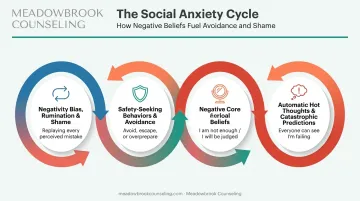
Here's how that plays out in four stages.
Stage 1: Negative Core Beliefs
At the root of the cycle sit deep-seated beliefs like "I'm fundamentally boring" or "people will see I don't belong." These beliefs act as a lens, filtering everything that happens afterward.
Example: Before ever speaking in a team meeting, someone assumes coworkers already see them as incompetent. That assumption colors every interaction that follows, long before any actual judgment occurs.
Stage 2: Automatic "Hot Thoughts" and Catastrophic Predictions
Once triggered, core beliefs generate rapid-fire, in-the-moment thoughts. Clinicians sometimes call these "hot thoughts" because they arrive fast and feel absolutely true in the moment.
Common distortions include:
- Mind reading — assuming you know someone's negative opinion without evidence
- Catastrophizing — treating a small stumble as guaranteed humiliation
- All-or-nothing thinking — believing an interaction was either a total success or total failure
Example: Walking into a party, someone immediately assumes everyone noticed their awkward entrance and is already judging them. That thought spikes a racing heart and a shaky voice before a single word is spoken.
Stage 3: Safety-Seeking Behaviors and Avoidance
To manage that surge of anxiety, people reach for safety behaviors: avoiding eye contact, over-rehearsing what to say, or leaving events early. These feel protective, but research shows they often backfire.
Experimental work found that using safety behaviors during conversation actually produced greater anxiety and stronger beliefs about appearing anxious, compared to dropping them altogether. Safety behaviors also increase self-monitoring, which pulls attention away from the actual conversation.
Example: Someone answers questions in short, flat responses to avoid saying "the wrong thing." This makes them appear uninterested, which pushes the other person to disengage, confirming the original fear of being disliked.
Stage 4: Negativity Bias, Rumination, and Shame
After the event ends, the cycle doesn't stop. Attention shifts to reviewing what went "wrong," while positive or neutral moments get filtered out entirely.
A 2024 meta-analysis found a moderate link between this kind of post-event rumination and social anxiety severity (r = .45). That's not proof rumination alone causes the disorder, but it does show how closely the two are tied together.
Example: Someone replays one stumble during a work presentation for days, while completely ignoring the positive feedback they received afterward. That rumination reinforces the belief "I'm not good at this," restarting the entire cycle for the next event.
What Happens When the Cycle Goes Unaddressed
Left alone, this cycle rarely stays the same size. It grows.
As avoidance increases, feared situations start to feel more intolerable, not less. Skipped opportunities pile up: declined invitations, avoided presentations, unspoken opinions in meetings. Over time, that pattern can lead to social isolation, missed career or academic opportunities, and a higher risk of co-occurring depression.
The scale of this issue is larger than most people realize. According to NIMH, an estimated 7.1% of U.S. adults experienced social anxiety disorder in the past year. Among those cases, 29.9% reported serious impairment and another 38.8% reported moderate impairment in daily functioning.
Those impairment numbers point to a deeper problem: how long people wait before getting help. Cross-national research on treatment-seeking found a median delay of 28 years between disorder onset and eventual treatment contact for social phobia. Only about 5% of people sought help within the first year after symptoms began.
Warning Signs You're Caught in the Cycle
Recognizing these patterns early makes it much easier to interrupt them before they escalate:
- Excessive pre-event worry — mentally rehearsing conversations or scenarios days before they happen
- Reliance on avoidance or "safety" props — canceling plans, arriving late, or gripping a drink to hide shaking hands
- Post-event replay — fixating on perceived mistakes hours or days after an interaction, while dismissing anything that went well
How to Break the Social Anxiety Cycle
Because the cycle feeds itself at multiple points, breaking it means interrupting thoughts, feelings, and behaviors, not just one piece of the puzzle. Cognitive-behavioral therapy (CBT) remains the most well-supported approach for doing exactly that.
A network meta-analysis of 101 trials involving over 13,000 participants found individual CBT significantly more effective than a waitlist for adult social anxiety disorder, with one of the largest effect sizes reported among psychological interventions for this condition.
Here's how that plays out practically.
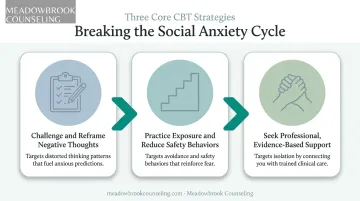
Challenge and Reframe Negative Thoughts
What to do: Identify distortions like mind-reading or catastrophizing as they happen, then ask what evidence actually supports (or contradicts) the thought. A simple thought record works well here: write the trigger, the automatic thought, and a more balanced alternative.
How it blocks the cycle: This stops "hot thoughts" from snowballing into full-blown physical anxiety and avoidance before they even get that far.
When to use it: Before anticipated social situations, or as a structured exercise between sessions.
Practice Exposure and Reduce Safety Behaviors
Two behavioral techniques work together to weaken the cycle from the outside in: facing feared situations directly and dropping the habits that make interactions feel forced.
What to do:
- Build a hierarchy of feared situations, from mildly uncomfortable to significantly anxiety-provoking, and work through it step by step, starting small.
- Drop habits like over-scripting responses or avoiding eye contact, and redirect attention outward, toward the conversation itself, rather than inward toward self-monitoring.
How it blocks the cycle:
- Exposure proves, through direct experience, that feared outcomes rarely happen the way the mind predicts, weakening the avoidance-driven loop at its source.
- Dropping safety behaviors removes the self-fulfilling prophecy where these habits make interactions feel more awkward and distant to others.
When to use it: Consistently, in small increments, paired with grounding or mindfulness techniques during real social interactions, ideally with guidance from a therapist trained in exposure work.
Seek Professional, Evidence-Based Support
What to do: Work with a licensed therapist trained in CBT or related approaches to personalize these strategies to your specific triggers and history.
How it blocks the cycle: Professional support addresses the root core beliefs directly and provides accountability that self-help alone often can't sustain.
When to use it: When anxiety is interfering with work, relationships, or daily functioning.
Meadowbrook Counseling's therapists work across CBT, DBT, EMDR, and related evidence-based modalities to personalize treatment for social anxiety, whether it's tied to a specific past experience or a longer-standing pattern of avoidance. Their team also offers insurance benefits verification before your first session, so you can focus on treatment instead of guessing at coverage.
Tips for Long-Term Management of Social Anxiety
Breaking the cycle once doesn't mean it can't resurface. A few habits help keep progress steady:
- Keep a simple thought journal. Tracking recurring unhelpful thoughts helps you spot patterns early and measure real progress over time.
- Continue practicing exposure, even after anxiety drops. Slipping back into avoidance is common once things feel "better," so continued practice matters.
- Build a support system. Trusted friends, family, or peer groups provide real-world practice and encouragement between therapy sessions.
- Schedule periodic check-ins with a therapist. Even brief follow-ups (including telehealth sessions with providers like Meadowbrook Counseling) can catch small setbacks before they grow into a full relapse.
Conclusion
The social anxiety cycle follows identifiable, predictable stages: a negative belief, a hot thought, a safety behavior, and a round of rumination that sets the stage for the next loop. Recognizing that pattern is what makes change possible.
Breaking it takes consistent practice, and for many people, professional guidance speeds up that process. Meadowbrook Counseling's therapists offer personalized, evidence-based therapy for social anxiety, along with support verifying your insurance benefits so starting treatment feels less overwhelming.
Frequently Asked Questions
What are the stages of social anxiety?
The cycle typically moves through anticipatory worry before an event, heightened anxiety and safety behaviors during it, and rumination or shame afterward. That rumination then reinforces the negative beliefs that start the cycle over again.
What is the best treatment for social anxiety disorder?
Cognitive behavioral therapy (CBT) has the strongest evidence base for treating social anxiety disorder, often through structured techniques like exposure exercises and thought records. Medication can play a complementary role for some individuals, but that decision is best made directly with a prescribing provider.
What triggers the social anxiety cycle to start?
Common triggers include upcoming social events, past negative experiences, or subtle cues of perceived judgment. These triggers activate underlying core beliefs, which then spark the anxious thoughts that drive the rest of the cycle.
How long does it take to break the social anxiety cycle through therapy?
Timelines vary by individual, but research trials often use structured CBT courses of around 14 to 16 sessions, roughly four months, to see meaningful improvement. Consistency between sessions tends to matter as much as the sessions themselves.
Is social anxiety the same as being shy?
No. Shyness is a personality trait, while social anxiety disorder involves persistent, distressing fear that substantially interferes with daily functioning. Research shows people with the disorder report greater impairment than shy individuals without it.
Can the social anxiety cycle be broken without therapy?
Self-help CBT techniques, like thought records and gradual exposure, can help with milder symptoms. Professional support is recommended once anxiety starts disrupting work, relationships, or daily life in a noticeable way.