
Many adults carry unexplained anxiety, chronic tension, or relationship patterns they can't quite trace back to a cause. Others wonder if what happened to them even "counts" as trauma, especially if it wasn't dramatic or obvious.
Here's the truth: 63.9% of U.S. adults report at least one adverse childhood experience, and 17.3% report four or more, according to CDC data pooled from 25 states. You are not broken, and you are not alone.
This guide covers the types of childhood trauma, how symptoms show up decades later, why they affect daily life the way they do, and the therapy approaches proven to help.
Key Takeaways
- Childhood trauma affects the majority of U.S. adults in some form
- Symptoms often present as Complex PTSD, affecting emotional, physical, and relational health
- Healing at any age is possible through EMDR, talk therapy, and other evidence-based approaches
- Personalized, trauma-informed care improves the odds of lasting recovery
Understanding Childhood Trauma and Its Types
The Adverse Childhood Experiences (ACEs) framework, developed by the CDC, defines childhood trauma as potentially harmful events occurring before age 18. This includes abuse, neglect, and household dysfunction that undermines a child's sense of safety.
Trauma isn't always a single dramatic incident. It can also be cumulative, meaning ongoing exposure over months or years. Research consistently shows a dose-response relationship: the more ACEs a person experiences, the higher their risk for adult health and mental health struggles.
The original 1998 ACE Study found that adults with four or more ACEs had 4 to 12 times higher odds of alcoholism, substance misuse, depression, and suicide attempts compared to those with none.
Common Types of Childhood Trauma
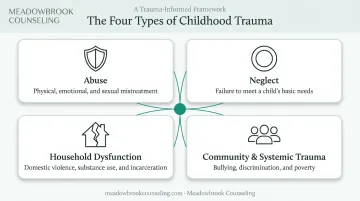
Childhood trauma generally falls into these categories:
- Abuse – physical, emotional, or sexual mistreatment
- Neglect – failure to meet a child's physical or emotional needs
- Household dysfunction – domestic violence, parental substance use, incarceration, or untreated mental illness in caregivers
- Community and systemic trauma – bullying, discrimination, poverty, or repeated medical trauma
Notice that none of these require a single catastrophic event. A childhood marked by chronic emotional unavailability from a parent can be just as impactful as one marked by overt abuse.
Recognizing the Symptoms in Adulthood
Trauma symptoms rarely stay confined to "feeling sad." They spread into the body, behavior, and thought patterns in ways that often go unrecognized for years.
Emotional and Physical Symptoms
Common emotional symptoms include chronic shame, hypervigilance, anxiety, and a persistent sense of not being good enough. These feelings often exist without an obvious present-day trigger.
The body keeps its own record. Survivors frequently report:
- Unexplained chronic pain
- Persistent fatigue
- Gastrointestinal problems
- Sleep disturbances
This isn't a coincidence. A large-scale analysis of 57 studies and over 826,000 adults found that childhood adversity was associated with a 45% higher likelihood of chronic pain in adulthood, with the risk climbing further among people with four or more adverse childhood experiences (ACEs).
Behavioral, Cognitive, and Relational Signs
Beyond physical symptoms, trauma shapes behavior and cognition in adulthood:
- Behavioral – avoidance, substance use, disordered eating, or self-harm as coping tools
- Cognitive – fragmented memories, dissociation, or difficulty trusting one's own recollections
- Relational – fear of intimacy, trouble trusting partners, or repeating unhealthy relationship patterns
When these symptoms cluster together, clinicians increasingly use Complex PTSD as the diagnostic framework. Unlike standard PTSD, Complex PTSD adds persistent disturbances in self-concept, emotional regulation, and relationships, capturing the full picture that survivors of prolonged childhood adversity often experience.
How Childhood Trauma Shows Up in Daily Adult Life
Trauma responses don't announce themselves. They show up disguised as everyday struggles that seem unrelated to the past.
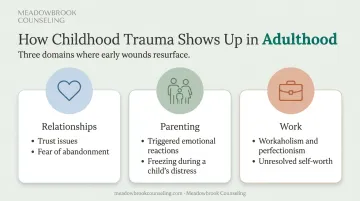
In relationships, survivors may struggle to trust a partner fully, fear abandonment even in stable relationships, or find that conflict triggers disproportionate emotional reactions. Research involving over 20,000 couples found childhood maltreatment linked to lower relationship satisfaction, and separate studies connect early neglect and abuse to insecure attachment styles in adulthood.
These same instincts don't disappear once survivors become parents.
Parenting often reopens old wounds unexpectedly. A child's tantrum or milestone can resurface a survivor's own unresolved trauma. Studies describe parents with maltreatment histories experiencing intrusive emotional reactions or freezing when their own child is distressed, not because they lack love, but because their nervous system is responding to old danger signals.
That same drive to prove worth can follow survivors into the workplace.
At work, trauma often masquerades as ambition. One study of over 1,100 young workers found childhood emotional abuse linked to workaholism, with maladaptive perfectionism acting as the connecting thread. Overachievement can become an unconscious way of proving worth that childhood never confirmed.
The Path to Healing: Therapy Approaches That Work
Recovery starts with one non-negotiable ingredient: a therapeutic relationship built on safety, trust, and validation. Without that foundation, no technique works well.
At Meadowbrook Counseling, treatment planning starts with understanding each client's specific history, strengths, and goals before selecting a modality, rather than applying the same protocol to everyone.
EMDR for Reprocessing Traumatic Memories
EMDR (Eye Movement Desensitization and Reprocessing) helps the brain reprocess stuck traumatic memories using guided eye movements or other bilateral stimulation. A systematic review of six randomized trials found EMDR reduced PTSD, depression, and anxiety symptoms in people with complex childhood trauma histories.
Meadowbrook Counseling's Rosario Toral, ACMHC, is a certified EMDR practitioner who works with clients processing trauma from childhood and beyond, helping them build resilience alongside symptom relief.
Talk Therapies: CBT and DBT
Cognitive Behavioral Therapy (CBT) is considered a strong first-line treatment for PTSD by the American Psychological Association. DBT-PTSD, a specialized version of DBT, showed a 58% remission rate in one clinical trial of women with abuse-related Complex PTSD, compared to 41% for a comparison treatment.
At Meadowbrook Counseling, therapists like Jonathan Nash, CMHC, and McKenna Rittmanic, CMHC, use CBT, DBT, and Trauma-Focused CBT to help adult survivors build emotional regulation and distress tolerance skills.
Somatic and Body-Based Approaches
Trauma lives in the body, not just the mind. Body-based approaches focus on nervous system regulation, helping clients release physical tension connected to past trauma. Polyvagal-informed techniques teach clients to recognize and regulate their own stress responses, complementing talk-based and reprocessing therapies for more complete healing.
| Approach | Best For | Evidence Level |
|---|---|---|
| EMDR | Reprocessing specific traumatic memories | Strong support for complex trauma |
| CBT/DBT | Building emotion regulation, distress tolerance | First-line for adult PTSD |
| Polyvagal-informed work | Nervous system regulation, body tension | Growing evidence, complementary |
Treatment works best when it's personalized, often combining two or three of these approaches based on each survivor's history and goals.
When and How to Seek Professional Support
It's time to reach out when trauma symptoms interfere with daily functioning, relationships, or basic well-being. The National Institute of Mental Health notes that PTSD symptoms lasting longer than one month and severe enough to disrupt work or relationships warrant a professional evaluation.
Signs worth paying attention to:
- Persistent distress that doesn't fade with time
- Relationship struggles that keep repeating
- Symptoms interfering with work, sleep, or daily tasks
Recognizing these patterns is only half the equation. Knowing what happens next makes reaching out feel far less daunting.
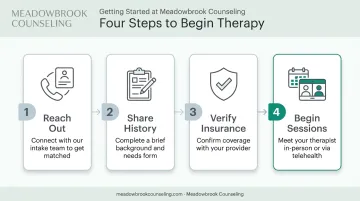
What to expect when starting therapy:
- Reach out through phone or an online contact form
- Share your concerns and history so the intake team can match you with a therapist suited to your needs
- Get clarity on costs upfront, since Meadowbrook Counseling's intake team verifies your insurance benefits before your first session
- Begin sessions, in person or via telehealth depending on location
Meadowbrook Counseling accepts major insurance plans including Aetna, Cigna, UnitedHealthcare, and Medicaid, with offices across Utah, Washington, Arizona, Wisconsin, Massachusetts, and Texas. Knowing coverage is handled in advance removes one more barrier to actually starting treatment.
Healing remains possible even decades after trauma occurred. Reaching out marks the first concrete step toward feeling different, no matter how long you waited to take it.
Frequently Asked Questions
What are the symptoms of childhood trauma?
Symptoms span emotional (shame, anxiety), physical (chronic pain, fatigue), behavioral (avoidance, substance use), and relational (trust issues, fear of intimacy) categories. Many survivors experience a mix of these rather than just one.
How can childhood trauma survivors heal?
Healing typically combines evidence-based therapy like EMDR, CBT, or somatic work with safe relationships and consistent self-care routines. Professional support tailored to individual history makes recovery more sustainable.
What types of childhood trauma affect survivors?
The main categories are abuse (physical, emotional, sexual), neglect, and household dysfunction such as domestic violence or parental substance use. Community-level trauma like bullying or discrimination also counts.
Can childhood trauma be fully healed or "cured"?
Trauma leaves lasting imprints, but symptoms can be greatly reduced and managed through therapy. Many survivors reach a point where trauma no longer controls their daily life.
How does childhood trauma affect adults differently than it affects children?
Adult survivors often experience delayed or fragmented symptoms tied to memory gaps and nervous system responses that developed to survive the original trauma. This can make the connection between past and present harder to see.
Is therapy really effective for trauma from decades ago?
Yes. EMDR and other trauma-focused therapies are specifically designed to treat long-past trauma effectively, regardless of when it occurred. Age and time since the event don't determine whether treatment can help.