

Introduction
You type "marriage counselor near me" into Google at 11 p.m., and forty tabs later, you're more confused than when you started. LMFT? LCSW? Psychologist? What's the actual difference, and does it matter for what you're going through?
It matters more than most people realize. A Licensed Marriage and Family Therapist is a specific, regulated profession with its own training path, its own exams, and its own clinical lens. Yet the credential often gets lumped in with "therapist" as a catch-all term.
This article breaks down what "licensed" actually means for an MFT, what they do in an actual session, and how marriage therapy differs from family therapy. It also covers how to find one who fits your situation, including through practices like Meadowbrook Counseling.
Key Takeaways
- LMFTs hold a master's degree, thousands of supervised clinical hours, and a state license.
- They treat individuals, couples, and families through a relational lens, not just married couples.
- Most LMFT treatment is short-term: research shows an average of 12 sessions.
- They can't prescribe medication and refer clients to a psychiatrist when needed.
What Does It Mean to Be a Licensed Marriage and Family Therapist?
An LMFT is an independently licensed mental health professional trained to treat clients through a relational, systemic lens. They sit alongside LCSWs, psychologists, and LPCCs as one of the core categories of mental health providers recognized across the U.S.
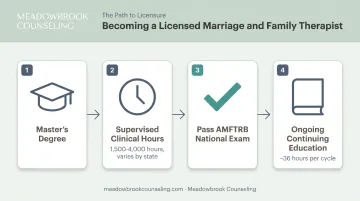
Getting there isn't quick. The typical path includes:
- A master's degree in marriage and family therapy, psychology, or a closely related field
- Several thousand hours of supervised clinical experience (the exact number varies by state, from roughly 1,500 hours in Florida to 3,000 hours in California and 4,000 hours in Minnesota)
- Passing the AMFTRB National Examination (or, in California, state-specific law, ethics, and clinical exams)
- Ongoing continuing education after licensure, often around 36 hours per renewal cycle in states like California
Licensure Means Accountability, Not a Marriage Requirement
Once licensed, an LMFT is bound by a professional code of ethics covering confidentiality, informed consent, and competence. They're legally authorized to diagnose and treat mental health conditions on their own, without a supervisor signing off on every case.
That same independence extends to who they treat. Despite the name, LMFTs aren't limited to married couples. They work with individuals, kids, couples, and entire families, always through a relational framework that considers how a person's environment shapes their symptoms.
To put the scale of the profession in perspective, marriage and family therapists held roughly 77,800 jobs across the U.S. in 2024, according to the Bureau of Labor Statistics. That's a substantial workforce dedicated specifically to relational mental health care.
What Does a Marriage and Family Therapist Actually Do?
LMFTs don't just treat the person sitting in the chair. They assess symptoms in context, asking how a client's anxiety, for instance, connects to their marriage, their parenting stress, or a strained relationship with a sibling. Therapists never view the individual in isolation.
Common Techniques and Approaches
LMFTs draw from several evidence-based modalities, often blending them based on what a client needs:
- Solution-focused therapy — present-oriented, identifying strengths and exceptions rather than digging into extensive history
- Structural family therapy — examining family hierarchy, boundaries, and subsystems
- The Gottman Method — a research-backed couples approach focused on conflict management and repair after hurtful interactions
- EMDR — a structured, phase-based approach for processing traumatic memories
- CBT adapted for couples and families — restructuring negative thought patterns that fuel conflict
Which combination a therapist uses often depends on the specifics of each case, and it typically shows up early, shaping how sessions unfold from the very first meeting.
A Typical Session and Treatment Timeline
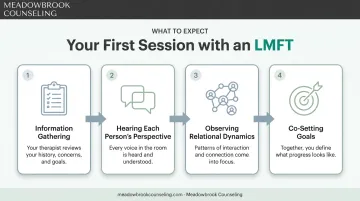
A first session usually looks less like "lying on a couch" and more like a structured conversation. Expect:
- Information gathering — the therapist asks about history, current stressors, and what brought you in
- Hearing each person's perspective — if it's a couple or family, everyone gets space to share their side
- Observing relational dynamics — how you talk to each other, interrupt, or avoid certain topics
- Co-setting goals — you and the therapist agree on what "progress" will look like
Treatment tends to be shorter than people expect. According to AAMFT, the average course of care runs about 12 sessions, with roughly 65.6% of cases wrapped up within 20 sessions. This isn't open-ended, decade-long therapy for most clients. It's usually goal-focused and time-limited.
Core Skills LMFTs Bring to Every Session
Whether treatment runs six sessions or twenty, a few foundational skills show up in every meeting, regardless of modality:
- Active listening that validates without taking sides
- Facilitating communication so partners or family members actually hear each other
- De-escalating conflict in real time, right there in the room
- Culturally responsive care that accounts for a family's background and values
Without these skills, even the most research-backed modality falls flat, and clients notice the difference immediately.
Marriage Therapy vs. Family Therapy: What's the Difference?
These two terms get used interchangeably, but they're not the same thing.
Marriage or couples therapy zeroes in on the two-person relationship. Sessions focus on communication patterns, intimacy, trust, and how partners resolve conflict with each other. It's a dyad-focused approach.
Family therapy widens the lens to the household as a whole. It might address parent-child conflict, sibling rivalry, or how one member's struggle, say, a teenager's anxiety, ripples outward and affects everyone else at home.
Here's the important part: LMFTs are trained in both formats, and they often shift between them within the same client's treatment plan.
A couple might start in joint sessions, then bring in a teenager for a few family sessions when a household issue surfaces, then return to couples work. The therapist adjusts the frame based on what the situation calls for, not the other way around.
What Issues and Conditions Do LMFTs Treat?
LMFTs handle a wide range of concerns, both individual and relational.
Individual concerns commonly treated:
- Anxiety and depression
- Grief and bereavement
- ADHD (often through family-based behavioral approaches)
- Trauma and PTSD
- Major life transitions, like divorce or a job loss
Relational concerns commonly treated:
- Marital conflict and communication breakdowns
- Infidelity recovery
- Parent-child conflict
- Blended family adjustment
- Divorce-related distress
At Meadowbrook Counseling, this range shows up in how clients get matched with therapists. Rather than a one-size-fits-all intake, individuals, couples, families, teens, and moms are paired with LMFTs and other clinicians trained in specific modalities suited to their concern.
Rosario Toral, for example, holds an ACMHC credential and EMDR certification. She works with clients navigating trauma, postpartum and maternal mental health issues, and grief, often blending EMDR with CBT and solution-focused approaches based on what each client needs.
LMFT vs. Other Mental Health Professionals
It's easy to lump all therapists together, but the training and focus differ in meaningful ways.
| Credential | Education | Primary Focus |
|---|---|---|
| LMFT | Master's degree + supervised hours + state exam | Relational, systemic treatment of individuals, couples, and families |
| LCSW | Master's degree + supervised hours + state license | Therapy plus resource connection and advocacy work |
| Psychologist | Doctoral degree (PhD/PsyD) + internship + license | Individual assessment, psychological testing, and psychotherapy |
A few key differences stand out:
- LMFT vs. LCSW: LMFTs stay focused on relational and systemic treatment. LCSWs often blend therapy with connecting clients to broader resources, like housing or social services.
- LMFT vs. Psychologist: LMFTs hold a master's-level relational credential. Psychologists complete years of doctoral training, often centered more on individual assessment and formal testing.
- Medication: LMFTs cannot prescribe medication. If a client needs medication management, they refer to a psychiatrist while continuing relational work in parallel.
How to Find the Right LMFT for You
Finding the right fit takes a bit more than picking the first name that pops up in search results.
Before booking, verify:
- The therapist's state licensure status
- Whether they specialize in your specific concern (trauma, EMDR, couples work, blended families, and so on)
- Their typical caseload and availability for your preferred format (in-person or telehealth)
Questions worth asking in an initial consultation:
- What's your experience treating this specific issue?
- What therapeutic approach do you use, and why does it fit my situation?
- How often do you recommend sessions, and roughly how long does treatment usually take?
Finding a provider who checks these boxes is easier with a practice built for specialty matching. Meadowbrook Counseling operates across multiple states, including Utah, Washington, Arizona, Wisconsin, Massachusetts, and Texas, with both in-person and telehealth sessions available.
Their intake process matches clients with therapists based on specialization, whether that's trauma-focused EMDR work like Rosario Toral provides, couples work using the Gottman Method, or family therapy for blended households.
The practice also supports insurance verification before your first appointment, since coverage can vary by therapist, location, and plan. Clients working with major carriers like Aetna, BCBS, Cigna, UnitedHealthcare, Medicaid, and TriCare can confirm their specific benefits through Meadowbrook's billing team ahead of scheduling. This step removes the guesswork around cost before your first session.

Frequently Asked Questions
What does it mean to be a licensed marriage and family therapist?
It means completing a master's degree, several thousand hours of supervised clinical experience, and passing state licensing exams. LMFTs are then legally authorized to diagnose and treat mental health conditions through a relational lens.
What is the difference between marriage therapy and family therapy?
Marriage therapy focuses on the two-person relationship, communication, trust, and conflict between partners. Family therapy widens the focus to the whole household, addressing how one member's struggle affects everyone else.
How do I know if I need to see an LMFT?
Signs include ongoing relationship conflict, communication that keeps breaking down, or a family member's struggle, like a teen's anxiety, that's rippling through the whole household. An LMFT can help whether you're coming in solo, as a couple, or as a family.
Can a licensed marriage and family therapist prescribe medication?
No. LMFTs cannot prescribe medication. If medication management is appropriate, they'll refer you to a psychiatrist or physician while continuing therapy alongside that care.
Does insurance cover sessions with an LMFT?
Many plans do, and since January 2024, Medicare has covered services from eligible LMFTs directly, according to CMS's physician fee schedule. Meadowbrook Counseling's billing team can verify your specific benefits before your first appointment.
How long does therapy with an LMFT usually take?
Treatment is typically short-term and goal-focused rather than open-ended. Many clients complete care within 12 to 20 sessions, though this varies based on the complexity of the concern.