
Introduction
You've done ERP. You've tried medication. Your OCD is better, but it's not gone, and somewhere along the way, someone mentioned EMDR. Maybe a friend, a forum, or even your own therapist floated it as a next step.
Here's where the confusion starts. EMDR has strong backing for PTSD, recognized by the World Health Organization as an effective trauma treatment. But its role in OCD is murkier, and a lot of what circulates online overstates what the research actually shows.
This guide breaks down what's proven, what's promising but preliminary, and where EMDR can genuinely help, or backfire, for people with OCD. We'll also cover how EMDR-trained clinicians, including therapists at Meadowbrook Counseling, think through this decision with clients.
Key Takeaways
- ERP remains the gold-standard OCD treatment; EMDR alone isn't a proven substitute
- EMDR paired with ERP shows promise in small studies, especially for trauma-linked OCD
- Using EMDR to erase intrusive thoughts, rather than process trauma, can backfire and reinforce avoidance
- The right approach depends on whether trauma fuels your OCD, not just its severity
Understanding OCD: More Than Just "Habits"
OCD isn't a preference for tidiness or a personality quirk. It's a clinical disorder built on two parts:
- Obsessions — intrusive, unwanted thoughts, images, or urges that cause real distress
- Compulsions — repetitive behaviors or mental rituals performed to reduce that distress or prevent a feared outcome
These thoughts are ego-dystonic, meaning they clash violently with a person's actual values. That's the key difference between clinical OCD and someone casually saying "I'm so OCD about my desk."
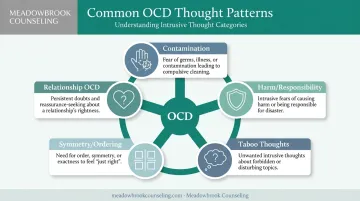
Common OCD Thought Categories
OCD shows up in themes far beyond cleanliness:
- Contamination — fear of germs, illness, or spreading harm through dirt
- Harm/responsibility — intrusive fears of hurting someone, even accidentally
- Taboo thoughts — unwanted sexual, religious, or violent intrusions that feel horrifying to the person having them
- Symmetry/ordering — needing things "just right" to prevent vague discomfort
- Relationship OCD (ROCD) — obsessive doubt about whether a relationship is "right" or whether one truly loves a partner
There's also a pattern some clinicians informally call meta-OCD: obsessing over whether your obsessing even counts as OCD. It's not a formal diagnosis, but it captures how the disorder can turn inward on itself.
Trauma history matters here, too: research on the overlap between OCD and trauma shows that roughly 54% of people with OCD report a trauma history, and higher adverse childhood experience (ACE) scores predict greater OCD severity. This connection is exactly why some clinicians explore trauma-focused therapies like EMDR alongside standard OCD treatment.
What Is EMDR Therapy, and How Does It Relate to OCD?
EMDR is an eight-phase therapy that uses bilateral stimulation, meaning guided eye movements, tapping, or alternating tones, to help the brain reprocess distressing memories. Researchers developed and validated it for PTSD, where it now sits alongside CBT as a WHO-recommended treatment.
For OCD, the process looks different. There's no single "obsession memory" to target in most cases, so adapted protocols have emerged:
- Flash-forward technique — instead of processing a past memory, the client imagines and processes the feared future catastrophe (like the worst-case outcome of a contamination fear)
- Attachment-focused adaptations — used when shame or early relational wounds seem tangled up in the OCD, helping clients build self-regulation skills before any reprocessing begins
- Standard protocol adaptation — used when clinicians can trace memories connected to when the OCD first took hold, even without one clear traumatic event
An Adaptation, Not the Original Protocol
EMDR was never designed with OCD in mind. Any use of EMDR for OCD is a clinical adaptation, built by practitioners experimenting with the framework, not the tested, standardized protocol that made EMDR effective for trauma. That distinction matters when you're weighing how much evidence actually supports it.
Does EMDR Actually Work for OCD? A Look at the Evidence
Here's the direct answer: no, not as a standalone, first-line treatment. According to the International OCD Foundation's treatment guide, EMDR is not currently considered an evidence-based treatment for OCD on its own. ERP, sometimes paired with medication, remains the gold standard.
Why the gap? The research base for EMDR and OCD is thin:
- Mostly small case series and individual case studies
- A handful of controlled trials, not the large randomized trials needed to call something "evidence-based"
- Mixed comparative results — one trial found EMDR performed similarly to CBT for OCD, while an earlier study found it outperformed the medication citalopram
What the Preliminary Data Shows
Some findings are genuinely encouraging, even if early. Preliminary case series research from Marr (2012) documented meaningful reductions in Y-BOCS scores (the standard OCD severity measure) among treatment-resistant patients who received EMDR combined with CBT-based approaches.
That word "combined" is doing a lot of work. The research doesn't suggest EMDR treats OCD on its own. Instead, EMDR may help as an adjunct to ERP when trauma is intertwined with the OCD, without replacing exposure-based work.
This adjunct conversation matters because ERP, while effective, doesn't work for everyone. An estimated one in four OCD patients doesn't fully respond to, or refuses, standard ERP, which is part of why researchers keep investigating options like EMDR rather than treating ERP as the final word.
When EMDR Can Help (and When It Can Backfire) in OCD Treatment
The clearest use case for EMDR in OCD is specific: the obsession is rooted in an identifiable traumatic memory. Think harm OCD that emerged after witnessing violence, or contamination OCD that took hold after a traumatic medical event.
Think of it like a gas leak. If OCD is the fire, ERP addresses it head-on. But if unresolved trauma is fueling that fire beneath the surface, EMDR can help close the valve, so the progress made in ERP actually holds.
Other Signs EMDR Might Be Appropriate
Beyond a clear traumatic origin, a few other clinical patterns suggest EMDR may help:
- ERP sessions repeatedly trigger trauma-level flooding, not typical OCD anxiety spikes
- A history of complex trauma or C-PTSD seems to be driving relapse despite solid ERP gains
- OCD themes cluster around shame-based core beliefs, such as "I am dangerous" or "I am fundamentally bad," that trace back to early experiences
When these markers show up, it's worth involving a clinician trained in both approaches.
The Real Risk: EMDR as Avoidance
Here's where it gets dicey. OCD thrives on avoidance, and EMDR can accidentally feed that if it's misused.
If someone tries to use EMDR to erase or neutralize intrusive thoughts, rather than process an actual traumatic memory, it backfires. It reinforces the exact belief ERP works to dismantle: that the thoughts are too dangerous to simply sit with. A well-trained clinician knows the difference between processing a genuine trauma memory that's fueling OCD symptoms, and inadvertently turning EMDR into a compulsion that bypasses the anxiety-tolerance skills ERP is built to strengthen.
That distinction is exactly why this work shouldn't be freelanced. It needs a clinician who understands both models well enough to know which one a given moment calls for.
What Combined EMDR and ERP Treatment Looks Like in Practice
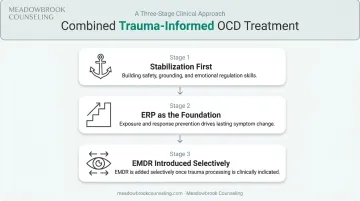
When trauma and OCD are genuinely intertwined, clinicians generally follow a deliberate sequence rather than mixing modalities freely.
- Stabilization first — grounding and self-regulation skills are established before anything else
- ERP as the foundation — exposure and response prevention work begins early to build the core skill of tolerating anxiety without compulsions
- EMDR introduced selectively — reserved specifically for identified traumatic memories that appear to be underlying or triggering OCD symptoms
A typical session in this combined approach might involve identifying the "first, worst, and most recent" activating experiences tied to the OCD, then mapping out a trauma timeline. Before any actual reprocessing starts, clinicians also build resourcing tools, like a "safe place" visualization or a mental list of supportive people.
This kind of integrated work depends entirely on the clinician. It requires someone trained in both modalities who can move between exposure work and trauma reprocessing without letting one undercut the other.
At Meadowbrook Counseling, Rosario Toral, ACMHC, is a certified EMDR practitioner who blends trauma processing with evidence-based, client-centered care. For OCD specifically, look for a therapist trained in both ERP and EMDR. That dual expertise is what this combined approach requires.
Questions Worth Asking a Prospective Therapist
- Do you think trauma is playing a role in my OCD?
- Are you trained in both EMDR and ERP specifically?
- Would ERP continue alongside EMDR, or would it pause while we do trauma work?
Finding the Right Support for OCD and Trauma
There's no universal formula here. The right mix of ERP, medication, and possibly EMDR depends on your specific trauma history and how your OCD symptoms actually present, not a generic protocol.
Meadowbrook Counseling supports this kind of nuanced matching through:
- A personalized therapist-matching process based on your specific history and symptoms
- Insurance verification support before your first session, so costs are clear upfront
- Locations across Utah, Idaho, Massachusetts, Florida, Texas, Colorado, Wisconsin, Washington, and Arizona, plus telehealth options

Reaching out early makes this kind of tailored support more effective, so don't wait until OCD feels unmanageable. As you vet potential therapists, favor those who are upfront about what is and isn't proven, rather than ones overselling a single technique as a cure-all.
Frequently Asked Questions
Is EMDR a good treatment for OCD?
Not as a standalone, first-line treatment. Emerging research suggests it may help as an adjunct to ERP, particularly when trauma underlies the OCD symptoms.
What to do when OCD is out of control?
Seek an OCD-specialized therapist trained in ERP right away, and resist reassurance-seeking or compulsions that fuel the cycle. Meadowbrook Counseling can match you with a specialist quickly.
What is an example of OCD thoughts?
Common OCD themes include contamination fears, harm-related fears, taboo intrusive thoughts, and doubt about relationships or symmetry. These thoughts conflict directly with the person's actual values, which fuels the distress.
What's the difference between EMDR and ERP for OCD?
ERP exposes you to feared triggers so you build tolerance without performing compulsions, while EMDR processes distressing memories through bilateral stimulation. They work through different mechanisms but are often combined for trauma-linked OCD.
How many EMDR sessions are needed for OCD?
There's no standardized number, since research here is still limited. Case studies often describe EMDR used over roughly 8 to 12 sessions alongside CBT or ERP, but this varies by individual.
Does insurance cover EMDR for OCD treatment?
Coverage depends on your specific provider and plan. Meadowbrook Counseling helps verify insurance benefits before your first session so you know your costs upfront.