"Mental health professional" isn't one job. It's an umbrella term covering psychiatrists, psychologists, therapists, counselors, and social workers, each with different training, different scopes of practice, and different ways of treating depression.
This guide breaks down each type of provider, what they actually do, and how to pick the right one for your situation, including how a practice like Meadowbrook Counseling helps match people with the right therapist from the start.
Key Takeaways
- Depression care often requires a team approach, combining medication management with talk therapy
- Only psychiatrists and psychiatric nurse practitioners can prescribe and manage medication
- Psychologists, therapists, and social workers provide evidence-based psychotherapy but don't prescribe
- The right fit depends on symptom severity, medication needs, budget, and personal comfort
- Many patients see better results from a collaborative care team than from one provider
What Is a Mental Health Professional?
A mental health professional is any licensed provider trained to diagnose and/or treat conditions like depression, anxiety, or trauma. That's the simple definition. The complicated part is that these providers differ in three key ways:
- Education level: ranging from a master's degree to a medical doctorate
- Scope of practice: whether they can legally prescribe medication
- Specialization: talk therapy, medication management, testing, or case coordination
This matters practically. A psychologist with a PhD and a licensed counselor with a master's degree both provide therapy, but only one typically does psychological testing.
A psychiatrist and a primary care doctor can both prescribe antidepressants, but only one specializes in mental health. Matching your specific need to the right credential saves time and gets you better care faster.
Why Getting the Right Type of Professional Matters for Depression
Depression doesn't look the same for everyone. Some people manage mild symptoms with weekly talk therapy. Others need medication, intensive support, or both. Picking the wrong type of provider for your situation can stall recovery for months.
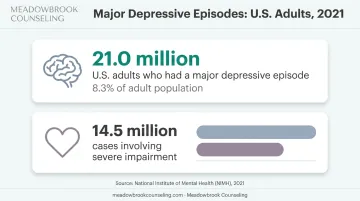
This isn't a niche problem. According to the National Institute of Mental Health, an estimated 21.0 million U.S. adults, or 8.3% of the adult population, had at least one major depressive episode in 2021, and 14.5 million of those cases involved severe impairment. Matching care to that severity is what determines whether treatment actually works.
Here's what commonly goes wrong without the right specialist:
- Undiagnosed conditions: a generalist misses signs of a more complex mood disorder
- Ineffective medication management: a non-specialist prescriber doesn't adjust dosing or try alternatives when the first medication doesn't work
- Therapy that skips the root cause: talk therapy without attention to trauma, grief, or situational stressors driving the depression
None of this means you need the "top" credential every time. It means matching the provider to the actual problem.
Types of Mental Health Professionals for Depression
No single provider does it all. Some specialize in medication, some in talk therapy, some in diagnosis, and some combine several of these. Many people end up seeing more than one type as part of a coordinated plan: a therapist for weekly sessions and a prescriber for medication, for instance.
Here's how the main provider types break down.
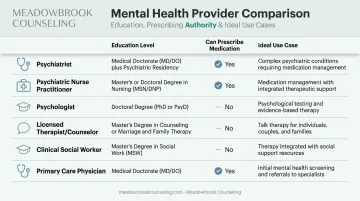
Psychiatrists (MD or DO)
Psychiatrists are medical doctors (MDs or DOs) who complete four years of medical school plus at least four years of psychiatric residency. That's roughly 12 years of training after high school. They can diagnose mental health conditions, prescribe and manage psychiatric medication, order medical tests, and provide psychotherapy.
Best for: severe depression, treatment-resistant cases, or situations where a co-occurring medical condition complicates treatment.
The trade-off: psychiatrist appointments are often short and focused mostly on medication check-ins, with less time for in-depth talk therapy compared to a dedicated therapist.
Psychiatric Nurse Practitioners (PNPs)
Psychiatric nurse practitioners, or PMHNPs, are advanced-practice nurses with graduate-level psychiatric training and national certification. They can diagnose, prescribe medication in most states, and provide some psychotherapy.
Best for: patients who need a prescriber but face long psychiatrist wait times, since PNPs are often more accessible.
The trade-off: prescribing authority varies by state. Some states grant full independent practice; others require a collaborative agreement with a physician, according to the American Association of Nurse Practitioners. Their psychiatric training, while substantial, is generally shorter than a psychiatrist's medical residency.
Psychologists (PhD or PsyD)
Psychologists hold doctoral degrees and specialize in psychotherapy, psychological testing, and diagnosis. Most cannot prescribe medication; only nine states currently allow specially trained psychologists limited prescribing authority.
Best for: people who want in-depth talk therapy, formal testing to confirm a diagnosis, or a complex psychological evaluation.
The trade-off: if medication becomes part of the treatment plan later, you'll likely need to pair a psychologist with a prescriber.
Licensed Therapists and Counselors (LPC, LMHC, LMFT, CMHC)
These master's-level clinicians provide psychotherapy using approaches like CBT, and many specialize in specific issues, including depression, trauma, or relationship stress. At Meadowbrook Counseling, therapists like Jonathan Nash (CMHC) and McKenna Rittmanic combine CBT, DBT, and EMDR to treat depression, often tailoring the approach as symptoms shift.
Best for: individuals, couples, or families who want regular talk therapy without medication management.
The trade-off: licensure titles and requirements vary by state, so it's worth verifying a therapist's specific credentials and depression experience before starting.
Clinical Social Workers (LCSW)
Clinical social workers combine talk therapy with practical case management, helping clients navigate stressors like housing instability, financial strain, or access to community resources alongside emotional support.
Best for: people whose depression is tied to situational or social stressors requiring both therapy and resource coordination.
According to the National Association of Social Workers, professional social workers make up the nation's largest group of mental health services providers, with more than 200,000 clinically trained members nationwide, more than psychiatrists, psychologists, and psychiatric nurses combined. That scale makes LCSWs widely accessible in most communities.
Primary Care Physicians (PCPs)
PCPs can screen for depression, prescribe basic antidepressants, and refer patients to specialists when needed. The U.S. Preventive Services Task Force recommends that all adults be screened for depression during routine care, with systems in place for accurate diagnosis and follow-up.
Best for: a first point of contact, especially for mild depression or when you're unsure where else to start.
The trade-off: PCPs generally have less specialized psychiatric training than dedicated mental health providers, making them a less ideal fit for complex or severe cases.
How to Choose the Right Mental Health Professional
The right choice depends on your symptoms and goals, not on picking the most advanced-sounding title. A psychiatrist isn't automatically "better" than a licensed counselor. It's about fit.
Weigh these factors:
- Symptom severity: mild depression often responds well to therapy alone; moderate-to-severe cases frequently benefit from adding a prescriber
- Medication needs: if medication might be necessary now or later, a psychiatrist or PNP should be part of your plan
- Budget and insurance: check what your plan covers and what providers are actually in-network near you
- Availability: some provider types have shorter wait lists than others in your area
- Specialization and approach: look for specific experience treating depression, whether through CBT, EMDR, or another modality
This is exactly where a dedicated intake process helps. Meadowbrook Counseling's intake team fields questions about therapist fit, insurance, and scheduling directly. The team also works to verify insurance benefits before your first session, so you're not guessing about coverage or cost when you're already stressed.
What to Check Before Finalizing Your Choice
A few final checks can save you from switching providers mid-treatment:
- Don't default to the "highest" credential. A licensed therapist or counselor is often sufficient, and more accessible, for mild-to-moderate depression than a psychiatrist.
- Verify licensure and experience. Check your state's licensing board to confirm active status, and ask how many depression cases the provider has treated recently.
- Ask about flexibility. Can this provider adjust your treatment, such as adding medication management, if your symptoms change over time?
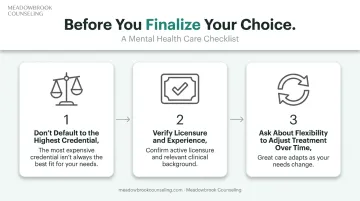
Depression treatment isn't static. A provider who can pivot with you, or coordinate with someone who can, tends to produce better long-term outcomes than one locked into a single approach.
Conclusion
Mental health professionals aren't interchangeable, and that's actually good news. Whether you need medication management, weekly talk therapy, or help navigating a stressful life situation alongside emotional support, there's a specific type of provider built for that need.
Understanding these differences saves you time and frustration: psychiatrists handle medication, psychologists offer testing and deep therapeutic work, and counselors and social workers provide accessible, ongoing support. Knowing which type fits your needs means less guessing and more time getting better.
Ready to find that fit? Meadowbrook Counseling's team can match you with a therapist experienced in depression treatment and walk you through your insurance benefits before you ever book a session.
Frequently Asked Questions
What professional can help with depression?
Psychiatrists, psychiatric nurse practitioners, psychologists, licensed therapists, and clinical social workers can all help, depending on whether you need medication, talk therapy, or both.
What are the treatment options for depression?
The main options are psychotherapy (such as CBT or IPT), medication, or a combination of both. Brain stimulation therapies like ECT are typically reserved for treatment-resistant cases.
How to help someone who is depressed?
Offer patience, encourage professional support, and stay connected without pushing too hard. Avoid judgment and let them lead the pace of getting help.
What not to say to someone with depression?
Avoid phrases like "just snap out of it" or "others have it worse." These minimize real symptoms. Instead, validate their feelings and acknowledge depression as a medical condition, not a character flaw.
Can a primary care doctor treat depression?
Yes, PCPs can screen, diagnose milder cases, and prescribe basic antidepressants. They often refer more complex or severe cases to a specialist.
Do I need a referral to see a psychiatrist or therapist?
It depends on your insurance plan and state. Some plans allow direct scheduling with a specialist, while others, like POS plans, require a PCP referral first.