

So you search for help and find "Trauma-Focused Cognitive Behavioral Therapy." Then you read further and discover it was built for children.
That's confusing if you're an adult trying to process a car accident, an abusive relationship, or childhood neglect finally catching up with you decades later. Here's the reassuring part: the techniques behind TF-CBT power some of the most effective, research-backed adult trauma treatments available. This guide breaks down how those principles apply to adults, what treatment looks like phase by phase, and how to find a therapist trained to guide you through it.
Key Takeaways
- TF-CBT's cognitive-behavioral core underlies adult treatments like CPT and Prolonged Exposure (PE)
- Recovery moves through three stages: stabilization, trauma processing, and integration
- Cognitive restructuring, exposure work, and psychoeducation reduce PTSD, anxiety, and depression symptoms
- A trauma-trained therapist and genuine safety matter more than any single label
What Is Trauma-Focused CBT, and Can It Really Help Adults?
Trauma-Focused CBT, as originally branded, is a conjoint parent-child protocol. Psychologists Judith Cohen, Anthony Mannarino, and Esther Deblinger integrated their separate approaches in 1997, initially for children recovering from sexual abuse. A joint treatment manual followed in 2006, and the model later expanded to cover other forms of childhood trauma.
So does that leave adults out? Not really. The label "TF-CBT" refers to a specific child-focused program. But the therapeutic engine underneath it, confronting rather than avoiding traumatic memories through structured cognitive-behavioral work, is the same engine driving adult treatments.
The APA's 2025 clinical practice guideline for adult PTSD gives a "Strong For" recommendation to CPT, PE, and trauma-focused CBT as first-line adult treatments. That last term describes a category of care, not proof that the branded children's protocol doubles as an adult one.
The Theory Behind Facing What You've Avoided
Two theories explain why this works:
- Emotional processing theory holds that exposure to a feared memory, done safely and repeatedly, weakens the fear response by introducing new, corrective information
- Social cognitive theory explains how trauma distorts beliefs about safety, trust, and self-worth, and how restructuring those beliefs (CPT's specialty) restores balance
Whatever it's called on your intake paperwork, adult trauma-focused CBT asks you to face the memory instead of running from it, at a pace you help set.
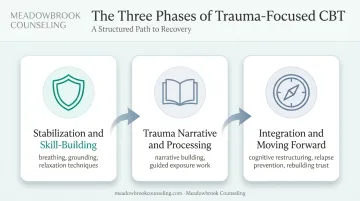
The Three Phases of Trauma-Focused CBT Explained
This outline offers a general roadmap for treatment. Adult protocols like CPT and PE don't always follow identical session counts, but they generally move through the same three arcs.
Phase 1: Stabilization and Skill-Building
Before touching the trauma itself, therapy focuses on safety and preparation. Your therapist explains how trauma affects the brain and body, then teaches practical coping tools:
- Paced breathing to calm your nervous system in the moment
- Grounding exercises to stay anchored in the present
- Relaxation techniques you can use between sessions
Phase 2: Trauma Narrative and Processing
Here's where the real work happens. You and your therapist collaboratively build a trauma narrative, or in PE's case, revisit the memory through guided imaginal exposure. The goal is gradually reducing the emotional charge attached to the memory until it stops controlling you.
Phase 3: Integration and Moving Forward
The final stretch centers on cognitive restructuring, meaning-making, and relapse prevention. You start rebuilding trust, in yourself and others, and reconnecting with situations you've avoided.
A note on timing: CPT generally runs about 12 sessions, while PE typically spans 8 to 15 sessions of 90 minutes each. Neither follows a fixed "12-16 session" rule; your therapist adjusts pacing based on your history and how you're responding.
One thing stays constant: you always control which memories get addressed and when. This control is the mechanism that makes exposure therapy work, not simply a courtesy.
Core Techniques and Real Benefits for Adult Trauma Survivors
Adult trauma-focused CBT draws from a specific toolkit:
- Cognitive restructuring – identifying and revising distorted beliefs ("I'm to blame," "No one is safe")
- Exposure-based exercises – gradual, repeated approach to avoided memories, people, or places
- Relaxation training – breathing and grounding techniques for managing physiological stress
- Problem-solving skills – structured approaches to real-world challenges trauma has complicated
- Assertiveness training – rebuilding the ability to set boundaries and voice needs
The evidence backing this isn't theoretical. In a randomized trial of 284 women in veteran and active-duty settings, 41.0% of participants who received Prolonged Exposure no longer met PTSD diagnostic criteria afterward. Only 27.8% achieved the same result with present-centered therapy, the comparison treatment. That's a meaningful gap, though results like these are study-specific, not a guarantee for any one person.
Beyond symptom reduction, clients typically notice:
- Better sleep and fewer intrusive thoughts
- Improved communication in relationships
- Steadier performance at work
- Reduced anxiety and depressive symptoms alongside PTSD improvement
One underrated benefit: these skills outlast treatment. They become a toolkit clients carry into whatever stress comes next, long after sessions end.
Trauma-Focused CBT vs. Other Trauma Therapies
Adults often ask how CPT, PE, and EMDR differ, since all three get recommended for PTSD.
| Therapy | Primary Focus | What Sessions Look Like |
|---|---|---|
| CPT | Restructuring distorted trauma beliefs | Socratic questioning, worksheets, examining "stuck points" |
| PE | Reducing avoidance through repeated exposure | In-vivo and imaginal exposure, followed by processing |
| EMDR | Memory reprocessing paired with bilateral stimulation | Guided eye movements while recalling the trauma memory |
CPT and PE share a CBT foundation but emphasize different mechanisms: belief change versus gradual exposure. EMDR takes a different route entirely, though clinicians still debate exactly how the eye movements contribute to results.
In practice, many therapists blend approaches rather than picking one lane. At Meadowbrook Counseling, EMDR-certified clinician Rosario Toral often draws from multiple evidence-based modalities depending on a client's trauma history and comfort level.
Other Meadowbrook therapists trained in EMDR pair it with trauma-focused CBT techniques, giving clients flexibility in how their treatment is structured.
Finding the Right Support for Your Healing Journey
Not every therapist who lists "trauma" on their profile has trauma-specific training. That distinction matters more than years in general practice.
Look for:
- Specific certification in CPT, PE, EMDR, or trauma-focused CBT, not just general counseling experience
- A therapeutic relationship where you feel safe, since trust is what makes trauma processing possible
- Willingness to move at your pace, particularly during exposure-based work
Meadowbrook Counseling meets these standards, offering personalized therapist matching across its Utah, Washington, Arizona, Wisconsin, Massachusetts, and Texas locations, both in-person and via telehealth. The intake team also verifies insurance benefits before your first session, so you're not left guessing about coverage while trying to start care. If you're ready to talk to someone, you can schedule a consultation to get matched with a trauma-trained clinician.

Frequently Asked Questions
Can trauma-focused cognitive behavioral therapy be used with adults?
The branded TF-CBT protocol was built for children, but its core principles form the basis of adult-adapted therapies like CPT and Prolonged Exposure. Adults absolutely benefit from this cognitive-behavioral approach to trauma.
What are the three stages of trauma-focused cognitive behavioral therapy?
Treatment generally moves through stabilization and skill-building, trauma narrative and processing, and integration. This structure applies across most evidence-based adult trauma treatments, not just one specific protocol.
What are the symptoms of complex PTSD?
There's no official "17 symptoms" list. The ICD-11 groups complex PTSD into six areas, including re-experiencing, avoidance, threat sensitivity, and emotional dysregulation. A clinician can offer a full diagnostic breakdown for your situation.
What should you not say to someone with PTSD?
Avoid minimizing phrases like "just move on" or "it wasn't that bad." Skip unsolicited advice and pressure to share details before they're ready. Instead, offer to listen and ask what kind of support actually helps.
How long does trauma-focused CBT typically take to show results?
Most adult protocols run 8 to 15 sessions, though some clients notice shifts earlier and others need more time. Progress depends heavily on trauma history, severity, and how consistently sessions happen.
Is trauma-focused CBT covered by insurance?
Most major insurance plans cover evidence-based trauma therapy as part of mental health benefits. Meadowbrook Counseling verifies your specific benefits before your first session, so there are no billing surprises once treatment starts.