
Introduction
Many adults carry anxiety, relationship struggles, or nagging self-doubt they can't quite explain. Often, the roots trace back to childhood experiences they've never examined. The CDC's ACE Study found nearly 64% of adults report at least one ACE.
There's a common mindset that gets in the way: "everyone had it rough" or "it wasn't that bad." This minimizing thought pattern feels protective, but it delays healing by keeping real experiences buried.
This guide offers categorized self-reflection questions, key behavioral signs to watch for, the trauma frameworks therapists actually use, and guidance on moving from awareness to professional support.
Key Takeaways
- Structured self-reflection questions help surface patterns often dismissed as "normal"
- According to the CDC, over 60% of U.S. adults report at least one adverse childhood experience
- Perfectionism, isolation, and memory gaps often trace back to childhood
- Self-awareness is a starting point, not a substitute for trauma-informed therapy
- EMDR and CBT are the most evidence-backed treatments for processing childhood trauma
What Is Childhood Trauma and Why Self-Awareness Matters
Childhood trauma isn't limited to abuse. It includes:
- Neglect — emotional or physical absence of care
- Household dysfunction — parental substance use, mental illness, or incarceration
- Witnessing violence — between caregivers or in the home
- Chronic instability — frequent moves, custody battles, financial upheaval
- Loss — death, divorce, or abandonment by a caregiver
This broader definition matters because a lot of people mentally file their history under "not that bad" simply because nobody hit them.
A 2023 CDC analysis of data from 25 states found that 63.9% of adults reported at least one adverse childhood experience, with 17.3% reporting four or more. That's not a small subset of the population. That's most people.
Structured self-reflection questions work because they surface patterns that have been normalized or buried over time. A vague question like "was your childhood hard?" rarely produces useful answers, since the brain tends to minimize familiar pain.
Specific, direct questions bypass that defense mechanism. That's exactly why therapists use them before treatment even begins.
Essential Therapy Questions to Ask Yourself About Childhood Trauma
These questions are adapted from clinical screening tools like the CDC-Kaiser ACE Study questionnaire and the Childhood Trauma Questionnaire. They're not diagnostic. They're a starting point for honest reflection.
Questions About Traumatic Events and Experiences
Ask yourself directly:
- Did a parent or adult in the household ever swear at you, insult you, or put you down repeatedly?
- Did anyone ever hit, spank, or physically hurt you in a way that left marks or bruises?
- Did an adult or older person ever touch you sexually or force sexual contact?
- Did you often feel that no one in your family loved you or thought you were important?
- Did you witness a parent or caregiver being hit, threatened, or hurt?
Vague questions like "was your childhood tough?" invite vague answers. Direct, specific wording forces the memory to surface, because many people reframed these events as normal discipline or "just how things were" at the time.
Questions About Family Environment and Household Dynamics
Consider the environment you grew up in:
- Did a parent or household member struggle with alcohol or drug use?
- Was anyone in your home involved with child protective services, foster care, or the legal system?
- Did you regularly feel unsafe, unheard, or invisible at home?
- Were you criticized harshly for minor mistakes, or held to standards other kids weren't?
One useful technique: ask the same question for two different age ranges, say ages 5 to 10 versus 11 to 15. Memories often shift dramatically between developmental stages, and a question that draws a blank for early childhood might unlock something specific for adolescence.
Questions About Present-Day Patterns Linked to Childhood
These questions connect the past to how you function now:
- Do you have noticeable gaps in your memory from childhood or adolescence?
- Do you struggle to trust people or stay in relationships long-term?
- Do you fear abandonment even in stable relationships?
- Do you feel chronically "different" from people around you, even close friends?
- Do you rely on food, alcohol, or other substances to manage stress or emotions?
Rather than answering yes or no, rate each one on a frequency scale: Never, Sometimes, Often, or Frequently. This captures intensity, not just presence, and gives you (or a therapist) a clearer picture of which patterns need attention first.
Recognizing Behavioral Signs of Unresolved Childhood Trauma
Self-reflection questions surface memories. Behavioral patterns confirm what those memories left behind.
Approval-seeking and perfectionism. Constant approval-seeking often develops when childhood affection felt conditional or scarce. Perfectionism follows a similar path. A 2024 study of young adults found that childhood emotional abuse was strongly linked to maladaptive perfectionism, suggesting the drive to be flawless started as a way to avoid criticism at home.
Discomfort with calm. Some people feel oddly anxious when life is peaceful, almost waiting for the next crisis. This isn't officially cataloged as a clinical diagnosis, but it lines up with how a nervous system wired for chronic unpredictability learns to treat stability as suspicious.
Codependency and compulsive caretaking. Kids forced into adult caregiving roles too early, known as parentification, often grow into adults who over-function in relationships. They manage everyone's emotions but their own.
Isolation and trust difficulties. Pulling away from others was often a survival skill in a chaotic home. Researchers studying maltreatment histories consistently find higher rates of loneliness and larger preferred physical distance from others in adulthood.
Memory gaps. Large, unexplained gaps in childhood memory can point toward dissociation, a common coping response when experiences were too overwhelming to fully process at the time.
None of these signs alone confirms trauma. Together, they form a pattern worth examining.
Understanding Trauma Frameworks: The 3 C's and 5 R's
Understanding Trauma Frameworks: The 3 C's and 4 R's
Therapists don't just ask questions. They apply structured frameworks to guide healing.
The 3 C's of Trauma-Informed Support
There isn't one single, standardized clinical model officially called "the 3 C's." However, many trauma specialists and counselors consistently describe three relational pillars that support recovery:
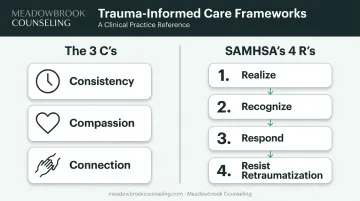
- Consistency — predictable, reliable interactions that rebuild a sense of safety
- Compassion — nonjudgmental responses that reduce shame around past experiences
- Connection — genuine relationships that counter the isolation trauma often creates
These aren't a rigid checklist. They're recurring themes across trauma-informed therapy approaches, and they explain why the relationship with a therapist matters as much as the technique used.
SAMHSA's Four R's of Trauma-Informed Care
The Substance Abuse and Mental Health Services Administration (SAMHSA) outlines this approach in its trauma-informed care framework, built on four core principles:
- Realize the widespread impact of trauma and potential paths to recovery
- Recognize the signs and symptoms of trauma in clients and others
- Respond by integrating trauma knowledge into every policy and practice
- Resist retraumatization at every stage of care
This framework guides how trauma-informed therapists structure sessions, from the intake paperwork to how they respond when a client shuts down mid-conversation.
From Self-Awareness to Healing: When and How to Seek Professional Support
Recognizing several patterns from these questions is a signal worth taking seriously: talking to a trauma-informed therapist could genuinely help, rather than continuing to manage these patterns alone.
A few evidence-based modalities build directly on the self-awareness you've gained:
- EMDR (Eye Movement Desensitization and Reprocessing): uses guided eye movements to help the brain reprocess stuck traumatic memories
- CBT, including trauma-focused variants: addresses the thought patterns that formed around early experiences
- Somatic approaches: focus on how trauma is stored in the bodyMeadowbrook Counseling brings these approaches to life through its trauma-focused clinicians. Rosario Toral, an EMDR-certified Clinical Mental Health Counselor, works with clients navigating complex trauma histories, combining clinical training with a trauma-informed, client-paced approach.
She's one of multiple EMDR-trained clinicians on staff, alongside therapists trained in trauma-focused CBT for those who prefer a cognitive-based approach.
Getting matched with the right therapist starts with a simple step: Meadowbrook's intake team helps connect you with a clinician suited to your specific history and goals, rather than leaving you to guess who's the right fit.
For readers worried about cost, Meadowbrook verifies insurance benefits before your first session. The practice also maintains offices across Utah, Washington, Arizona, Wisconsin, Massachusetts, and Texas, with telehealth options available at many locations for those who'd rather start from home.
Frequently Asked Questions
What questions should I ask about childhood trauma?
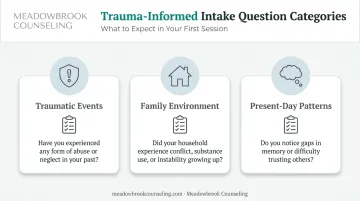
Effective questions cover three areas: traumatic events (abuse, neglect, violence), family environment (substance use or excessive criticism), and present-day patterns (trust issues, memory gaps, coping habits, and emotional avoidance). Direct wording surfaces more than vague questions.
What are the 3 C's of trauma?
While not one official clinical model, the 3 C's commonly refer to Consistency, Compassion, and Connection, three relational qualities that support trauma recovery within therapy and caregiving relationships.
What are the 5 R's of trauma?
SAMHSA's official framework outlines Four R's: Realize, Recognize, Respond, and Resist retraumatization. This guides how trauma-informed providers structure care and avoid re-traumatizing clients.
How do I know if I have unresolved childhood trauma?
Recurring patterns like people-pleasing, trust issues, chronic perfectionism, or unexplained memory gaps are common indicators. These patterns are worth exploring with a therapist rather than diagnosing on your own.
Can self-awareness alone heal childhood trauma, or do I need therapy?
Self-awareness is a valuable first step, but it rarely resolves trauma on its own. Lasting healing typically requires professional, evidence-based therapy such as EMDR or trauma-focused CBT.
What is the best type of therapy for processing childhood trauma?
EMDR and trauma-focused CBT are the most commonly recommended, evidence-backed options. The right choice depends on your specific history, symptoms, and comfort level with each approach.