This guide is for parents, caregivers, and adults who've noticed separation anxiety symptoms disrupting school mornings, bedtime, work schedules, or basic daily routines. Maybe your child melts down every time you leave for work. Maybe you're an adult who can't shake dread when a partner travels.
CBT is frequently recommended as a first-line treatment, but it's often reduced to "just talk therapy." It's not. Here's what CBT for separation anxiety actually involves, how it works step-by-step, and when it's the right fit.
Key Takeaways
- CBT pairs cognitive restructuring with gradual, real-life exposure to separation
- Treatment usually runs 12-16 sessions across several months, not weeks
- Caregiver consistency matters more for younger children than for teens or adults
- Comforting avoidance often backfires, reinforcing the exact fear CBT targets
- Medication can supplement CBT in severe cases, but it doesn't replace therapy
What Is CBT for Separation Anxiety Disorder?
Separation anxiety disorder involves excessive, developmentally inappropriate fear about being away from home or attachment figures. It's persistent, not situational, and it interferes with daily functioning.
Clinicians reference DSM-5-TR criteria to confirm a diagnosis before treatment begins. A person needs at least 3 of 8 symptoms, such as:
- Excessive distress during separation
- Fear that harm will befall an attachment figure
- Refusal to sleep away from home
- Repeated physical complaints tied to separation
Duration matters too:
- At least 4 weeks for children and adolescents
- 6 months or more for adults
- Symptoms must cause real distress or impairment, not just discomfort
CBT vs. General Talk Therapy
CBT for separation anxiety is time-limited and structured. It targets the loop connecting anxious thoughts, physical symptoms (racing heart, stomachaches), and avoidance behavior (refusing school, clinging to a parent).
The goal is to help the person tolerate separation, reduce avoidance, and build coping skills appropriate to their independence level, rather than eliminate anxiety completely.
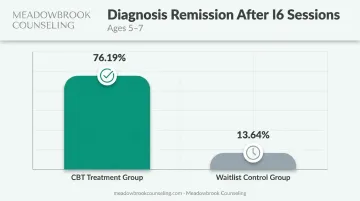
Research backs this specificity. A randomized trial of family-based CBT in children ages 5-7 found that 76.19% of treated kids lost their separation anxiety diagnosis after 16 sessions, compared to just 13.64% on a waitlist. That's a substantial gap, and it's why generic supportive talk therapy typically isn't the first recommendation.
CBT can be delivered one-on-one, with heavy family involvement, or in group settings, depending on the client's age and symptom severity.
How CBT Treatment for Separation Anxiety Works
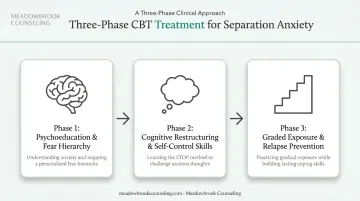
Treatment generally unfolds across three functional phases: education, active exposure, and relapse prevention. It's not always three neatly equal chunks, but the progression holds across most protocols.
Before any exposure work starts, a clinician conducts an assessment to pinpoint specific separation triggers, whether that's school drop-off, sleepovers, or a parent traveling for work. From there, therapist and client build a fear hierarchy, a ranked list of separation scenarios from least to most distressing.
Clinicians control pacing using anxiety rating scales, sometimes called a "fear thermometer," running roughly 0 (no anxiety) to 8 or 10 (maximum anxiety). This keeps exposures challenging without overwhelming the client.
As treatment progresses, most clients experience:
- Fewer physical anxiety symptoms during separation
- Reduced avoidance and clinginess
- Greater tolerance for independence, even in situations that once felt impossible
Step 1: Psychoeducation and Building the Fear Hierarchy
The first stage focuses on recognition: the client learns to identify how anxiety shows up physically (stomachaches, sweating), behaviorally (avoidance, refusal), and cognitively (catastrophic predictions). This groundwork makes the fear hierarchy possible, since a client can't rank fears they haven't yet named.
Step 2: Cognitive Restructuring and Self-Control Skills
Once the client can identify anxious patterns, treatment shifts to challenging them. A common tool is the STOP method:
- S – Scared: Notice the fear, physical sensations, and urge to avoid
- T – Thoughts: Identify the specific negative thought ("Something bad will happen if I'm not there")
- O – Other thoughts: Generate a more balanced, evidence-based alternative
- P – Praise: Reinforce the effort to respond differently, regardless of outcome
The goal is interrupting automatic catastrophic thinking long enough for the client to consider other possibilities, not manufacturing forced positivity.
Step 3: Graded Exposure and Relapse Prevention
This is where the fear hierarchy gets put to work. Clients practice separation scenarios in small, manageable steps, sometimes imagined first, then real. A child might start with a parent leaving the room for two minutes before working up to a full day at school.
Treatment concludes by reinforcing continued practice and normalizing setbacks. Progress isn't linear, and an occasional hard day doesn't undo months of gains. Therapists at Meadowbrook Counseling apply this same structured approach, adjusting the pace and triggers to fit each client's age and circumstances.
Who CBT Helps & Where It's Applied
CBT for separation anxiety shows up across a wide range of real-world situations:
- School refusal or repeated tardiness tied to separation fear
- Sleepovers and overnight independence
- Daycare transitions or first-time childcare
- Adults returning to in-person work or social settings after avoidance patterns set in
Age shapes treatment approach: Younger children typically need heavier caregiver involvement, reward systems for "brave" behavior, and parent coaching on avoiding accommodation. Teens and adults tend to work more independently on cognitive restructuring, applying real-world exposure without a parent orchestrating each step.
Regardless of age, finding a therapist trained specifically in exposure-based CBT matters most. Not every general talk therapist runs structured exposure work, and separation anxiety responds best to that specific skill set.
At Meadowbrook Counseling, families and adults can request personalized therapist matching and insurance verification across multiple states. This cuts down the time between recognizing symptoms and starting treatment with the right specialist.
Key Factors & Common Misconceptions
Key Factors That Influence Treatment Success
Several variables shape how quickly and fully someone responds to CBT:
- Caregiver participation and consistency, particularly for younger children
- Severity and duration of symptoms before treatment starts
- Age, which affects how exposures and skills are taught
- Co-occurring anxiety disorders, which can complicate or slow progress
- Session attendance and homework completion, since exposure practice between sessions drives most of the change
Common Misconceptions About CBT for Separation Anxiety
CBT is not a quick fix. Meaningful change usually takes weeks to months of consistent practice, not a single breakthrough session.
Comforting avoidance backfires over time. It feels natural to soothe a distressed child by letting them skip the scary event, but this kind of accommodation can reinforce the very avoidance CBT is designed to break. Research on treated youth has linked higher caregiver accommodation to noticeably lower odds of remission.
Exposure is nothing like forcing distress. Exposures are gradual and agreed upon in advance, not abrupt or coercive. A therapist won't push a child into a full-blown panic; they'll build up to challenges methodically.
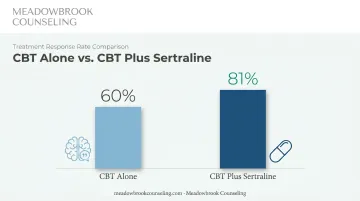
Needing medication doesn't mean CBT failed. In more severe cases, SSRIs are sometimes added alongside CBT. One well-known trial found response rates of 81% for combined CBT plus sertraline, versus 60% for CBT alone, according to findings reported by the National Institute of Mental Health. Combination treatment reflects severity, not therapy failure.
Conclusion
CBT treats separation anxiety disorder by combining psychoeducation, cognitive restructuring, and graded exposure to reduce avoidance and build lasting coping skills. This methodical, research-backed approach works best when caregivers or adults understand what each phase requires.
Knowing the process helps you set realistic expectations and actually support treatment, rather than unintentionally undermining it through well-meaning accommodation.
When those symptoms start disrupting school, work, sleep, or daily life, connecting with a qualified therapist for an evaluation, such as the licensed clinicians at Meadowbrook Counseling, is the next step toward lasting relief.
Frequently Asked Questions
How can cognitive behavioral therapy (CBT) help treat separation anxiety in adults?
CBT helps adults identify catastrophic thoughts about separation, then practice tolerating independence through structured exposure exercises. It also builds coping strategies for physical symptoms, with far less caregiver involvement than child-focused treatment.
When does separation anxiety end?
Developmentally normal separation anxiety typically resolves by ages 2-3. Separation anxiety disorder, however, can persist into adolescence or adulthood without treatment. With CBT, many people see improvement within a few months.
What are the DSM-5 criteria for separation anxiety disorder?
DSM-5-TR requires excessive, developmentally inappropriate fear about separation, lasting 4+ weeks in children or 6+ months in adults. Symptoms include distress, worry about harm to loved ones, or physical complaints tied to separation.
How long does CBT treatment for separation anxiety usually take?
Treatment length varies, but many protocols run 12-16 sessions over roughly three to four months. Consistency with practice between sessions plays a big role in how quickly progress shows up.
Can separation anxiety disorder be treated without medication?
Yes. CBT alone is often effective as a first-line treatment. Medication is typically considered only when symptoms are severe or progress stalls despite consistent therapy.
Is parental involvement necessary for CBT to work in children?
It's not strictly required, but caregiver involvement in reinforcing exposure practice and avoiding accommodation behaviors improves outcomes for younger children.