Those pieces are decades old, and the research landscape has changed substantially since then. Evidence-based approaches developed and refined over the past 20-plus years show far more encouraging outcomes than that older narrative suggests.
This article breaks down the real numbers: what "success" actually means in a clinical context, which factors most influence whether counseling works, and how couples can improve their odds. We'll also touch on how practices like Meadowbrook Counseling apply personalized, evidence-based care to couples work across their locations.
Key Takeaways
- About 70% of couples who complete therapy report lasting improvement, per research reviews
- Emotionally Focused Therapy achieves 70-75% recovery, with gains often lasting two years
- Success sometimes means separating with more clarity, not just staying together
- Timing and both partners' genuine engagement predict outcomes more than any other factor
- Most couples see measurable change within 8-20 sessions of active engagement
What Is the Success Rate of Marriage Counseling?
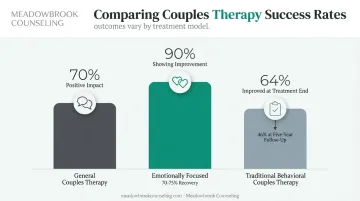
The most frequently cited figure comes from a 2012 review by Lebow, Chambers, Christensen, and Johnson published in the Journal of Marital and Family Therapy. Their conclusion: couple therapy positively impacts about 70% of couples who receive treatment.
That's an important distinction: "positive impact" isn't the same as saved marriage. It reflects broad improvement across satisfaction, communication, and emotional wellbeing, not a guarantee of reconciliation.
The American Association for Marriage and Family Therapy separately reports that almost 90% of clients say their emotional health improved after treatment. That figure covers the general population of marriage and family therapy clients, not couples exclusively, so it shouldn't be read as a 90% couples success rate.
Compare that to the 1980s. A 1984 reanalysis by Jacobson and colleagues found clinically significant improvement ranging from roughly 21% to 58%, depending on how outcomes were measured. The field has moved forward, but the improvement isn't uniform. It depends heavily on which treatment model a couple receives.
Emotionally Focused Therapy (EFT) Success Rates
Emotionally Focused Therapy has some of the strongest research support of any couples modality. According to the International Centre for Excellence in Emotionally Focused Therapy, EFT produces 70-75% recovery from significant relational distress, with nearly 90% of couples showing measurable improvement.
A 1999 meta-analysis by Johnson and colleagues found large effect sizes for marital adjustment, with recovery rates climbing from around 38-50% at the end of treatment to 70-73% at short-term follow-up.
A separate two-year follow-up study, though limited to a small sample of 32 couples (21 provided long-term data), found that relationship satisfaction and attachment gains generally held over time.
Reviews of the research, including Wiebe and Johnson's 2016 analysis, consistently support EFT as one of the better-performing approaches for long-term relational change. Small sample sizes across several of these studies mean the numbers should be treated as strong signals, not absolute guarantees.
Traditional Behavioral Couples Therapy Rates
Traditional Behavioral Couples Therapy (TBCT) tells a more mixed story. In one major clinical trial, 64% of couples improved or recovered by the end of treatment. That number dropped over time: at five-year follow-up, only about 46% still showed reliable improvement, and nearly 28% had divorced or separated.
Relapse is commonly discussed in this context too, with estimates suggesting 30-50% of couples experience setbacks within two years of finishing treatment. This gap between short-term gains and long-term durability is exactly why modality matters.
The takeaway: success rates shift depending on how "success" is measured, which model the therapist uses, and how well-trained that therapist is in couples-specific work.
What Does "Success" Actually Mean in Marriage Counseling?
Researchers don't track a single "did the marriage survive" metric. Instead, they measure:
- Relationship satisfaction (often via tools like the Dyadic Adjustment Scale)
- Communication patterns — both observed and self-reported
- Emotional closeness and attachment security
- Individual mental health, including reduced anxiety and depression symptoms
This matters because success doesn't always mean staying together. Sometimes it means separating with less conflict, more clarity, and healthier co-parenting arrangements. A couple that ends their marriage with mutual understanding, rather than bitterness, has still had a successful outcome by clinical standards.
Short-term gains and long-term outcomes are also different animals:
- Short-term: Many couples feel noticeably better within just a few sessions.
- Long-term: Without continued practice of new communication skills, those early gains often fade once therapy ends.
Ongoing practice outside the therapy room is what makes change stick.
Lebow's review found that the average person completing couples therapy is better off than 70-80% of people who receive no treatment at all, regardless of what ultimately happens to the relationship.
That's a meaningful benefit even for couples who eventually part ways.
This also debunks a common myth. Marriage counseling isn't reserved for relationships on the brink of divorce, and it doesn't promise reconciliation. Couples who seek support proactively, before resentment builds for years, tend to see the strongest results.
Factors That Determine Whether Marriage Counseling Works
Several factors shape whether therapy actually helps a couple, though some matter far more than others:
- Timing: Gottman's research cites an average six-year delay before couples seek help, while a 2021 study led by Doherty found a shorter gap of about 2.68 years, with 64% waiting two years or less. Regardless of the exact number, earlier intervention produces better outcomes than waiting until resentment sets in.
- Both partners' engagement: This is the single biggest predictor of success. One resistant partner can cap what therapy achieves, no matter how skilled the therapist is.
- The right modality for the issue: EFT tends to excel with attachment-related disconnection and trust repair, while other approaches fit better for specific communication or behavioral patterns. A mismatch between method and problem limits progress.
- Therapist training in couples work: A therapist trained only in individual counseling may unintentionally take sides or let conflict spiral unchecked during sessions, common mistakes that derail progress fast.
- Unresolved individual issues: Untreated depression, anxiety, or substance use can undermine couples work if not addressed alongside relationship sessions. Most evidence-based models treat active substance abuse or ongoing infidelity as issues requiring separate or concurrent attention.
How Long Should You Try to Fix Your Marriage?
There's no universal timeline that fits every couple. That said, research offers useful benchmarks:
- Meaningful change often begins within 8-12 sessions for couples who are actively engaged
- Most couples see measurable results within 20 sessions, based on typical treatment protocols across modalities
- Average session counts for marital and couple cases tend to run around 11-12 sessions in practice data, though this reflects utilization, not guaranteed outcomes
Rather than counting months or years, a better signal is continued willingness. Are both partners still showing up? Are they applying what they've learned between sessions, or just going through the motions?
Relationships that have carried entrenched conflict for years can still improve, provided both partners genuinely commit to the process. Duration matters less than depth of engagement.
How to Increase Your Odds of Success in Counseling
A few practical steps meaningfully improve the likelihood that counseling works:
- Seek help sooner rather than later. Waiting years to address recurring conflict makes patterns harder to unwind.
- Choose an evidence-based approach, such as EFT or the Gottman Method, delivered by a therapist specifically trained in couples work rather than individual therapy alone.
- Practice between sessions. Applying communication skills outside the therapy room is often what separates lasting change from a temporary bump in satisfaction.
- Remove practical friction points. Confusing insurance coverage or a poor therapist fit are common reasons couples drop out before real progress happens.
This last point is where many couples stall out. Meadowbrook Counseling addresses it directly by verifying insurance benefits before a couple's first session and matching couples with therapists trained in approaches like the Gottman Method and EFT.
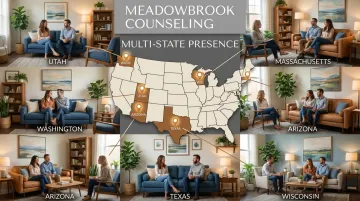
Its offices span Utah, Washington, Arizona, Wisconsin, Massachusetts, and Texas, reducing scheduling friction for many couples. Fewer logistical barriers means more couples stay consistent long enough to see results. If you're weighing your options, reaching out for an initial consultation is a reasonable first step before committing to a specific timeline.
Frequently Asked Questions
What is the success rate of marriage counseling?
Research reviews put general couples therapy at roughly a 70% positive impact rate, while Emotionally Focused Therapy specifically shows 70-75% recovery from significant distress. Outcomes vary based on modality, therapist training, and both partners' engagement.
How long should I try to fix my marriage?
There's no fixed timeline, but most couples notice meaningful change within 8-20 sessions if both partners stay engaged and practice new skills outside of sessions. Continued willingness matters more than a set number of months.
Does marriage counseling work for infidelity?
Emotionally Focused Therapy has shown effectiveness in resolving attachment injuries, including infidelity, often within about a dozen sessions in research studies. Success still depends heavily on both partners being genuinely willing to do the work.
Does marriage counseling work if only one partner wants to go?
Individual therapy can still help the willing partner process their experience, but lasting relational change generally requires both partners to participate in couples sessions. One resistant partner limits what's achievable.
Does online marriage counseling work as well as in-person?
Preliminary research, including a small randomized trial comparing videoconferencing to face-to-face couples therapy, found comparable improvements in relationship satisfaction across both formats. Larger studies are still needed, but early evidence is encouraging.
How do I know if my marriage can be saved?
Even relationships with years of entrenched conflict can improve with the right treatment approach and a therapist trained specifically in couples work. A trained clinician can help assess readiness and outline realistic next steps for your situation.